


Designed and manufactured in Badalona since 1962
Pressure relief valves
They hold upstream pressure at the set pressure: when it is exceeded, they open in proportion to the rise and discharge the excess, with no auxiliary power. They are also called excess pressure valves. Six spring, piston, diaphragm, or bellows models for steam, water, oil, compressed air, and gases.
- SizesDN15 to DN150
- Set pressure0.01 to 20 barg
- Pressure ratingPN25 – PN40
- Temperatureup to 220 °C
Questions about the set pressure or the model? Call 933 720 888 or email valfonta@valfonta.com.
Find your relief valve
Fluid
Set pressure
Size
- In-house design and manufacturing in Badalona
- Set pressures from 10 mbar to 20 barg
- No auxiliary power: they run on the process fluid itself
- Genuine spare parts for each model
Pressure relief valve models
Filter with the search tool in the header or switch to the comparison table. Each product page includes the complete specifications, the exploded view, installation, and PDFs.
Small lines: DN15 to DN25
Compact, in 316L stainless steel, threaded or flanged. Set pressures from 10 mbar (PRV55) to 12 barg (PRV54).

Piston
PRV53
Piston excess pressure valve in 316L stainless steel.
Set pressure
0.5 to 10 barg 15 on request
Size
DN15 to DN25
Temperature
up to 150 °C depending on gaskets
Steam
No
Choose it if you work with water, fuel oil, compressed air, nitrogen, or other inert gases.
Bellows · steam
PRV54
Bellows-balanced excess pressure valve in 316L stainless steel.
Set pressure
0.5 to 12 barg
Size
DN15 to DN25
Temperature
up to 210 °C depending on gaskets
Steam
Yes
Choose it if the fluid is steam, or liquids and gases above 150 °C.

Diaphragm · low pressure
PRV55
Diaphragm excess pressure valve in 316L stainless steel.
Set pressure
0.01 to 8 barg
Size
DN15 to DN25
Temperature
−10 to 150 °C with Viton gaskets
Steam
Yes
Choose it if you need very low set pressures, from 10 mbar, with gases, liquids, or steam.
Medium and large lines: up to DN150
Carbon steel or CF3M stainless body, with EN or ANSI flanges; bronze, duplex, or super duplex on request.
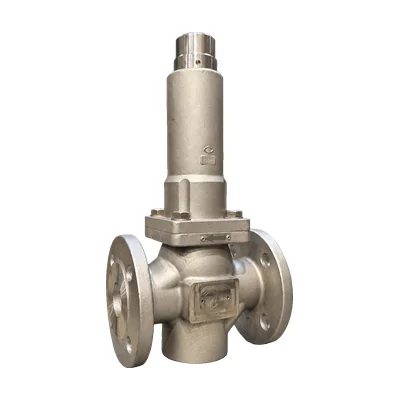
Spring · direct-acting
S3
Direct-acting relief valve with guided plug and Class IV or VI seat leakage. Approved for fire protection.
Set pressure
0.5 to 20 barg
Size
DN15 to DN150 DN125–150 on request
Temperature
up to 220 °C
Steam
Yes
Choose it if you need a direct-acting valve, with no diaphragm or control line, up to 20 barg; for example, in a pump bypass.

Diaphragm and bellows
S1
Globe-type excess pressure valve with diaphragm, up to DN150 and Kv 240 m³/h.
Set pressure
0.5 to 15 barg
Size
DN15 to DN150
Temperature
up to 220 °C
Steam
Yes with condensate pot
Choose it if you need high flow rates, up to DN150, or steam up to 220 °C.

Diaphragm · internal sensing
S2
Diaphragm excess pressure valve with plunger-balanced seat.
Set pressure
0.02 to 10 barg
Size
DN15 to DN100
Temperature
up to 180 °C
Steam
At low temperature with external sensing
Choose it if you need low set pressures, from 0.02 barg, with gases, compressed air, or liquids, without a control line.
Data from the Valfonta excess pressure summary catalog (2025); S2 set pressure from its datasheet. All accept water, oil, air, and non-flammable gases. * The S4 has no datasheet on the website: contact us. S3: DN125 and DN150 on request. PRV53: up to 15 barg on request.
No standard model matches these filters. Valfonta adapts models and designs custom valves: tell us about your application in the form or see the custom design service.
How it works and where it is installed
A pressure relief valve stays closed while the inlet pressure is below the set pressure. When the set pressure is exceeded, the valve opens gradually, in proportion to the pressure rise, discharges the excess flow, and closes again when the pressure returns to normal. This keeps the upstream pressure stable.
All of them are self-operated: an adjusting spring opposes the inlet pressure, with no air, electricity, or control system. The set pressure is fixed by the spring compression; the S1, S2, and S3 are delivered set to the requested value.
The typical installation is on a branch line, for example in a pump bypass, returning to the suction or the tank, with a strainer ahead of the valve and a pressure gauge upstream. See how to check the set pressure and why a relief valve chatters.
- Pump or equipment that generates the pressure
- Upstream pressure gauge
- Pressure relief valve
- Return to the suction side or to the tank
- Main line to the point of use
Relief, safety, or reducing: which one you need
| Relief or excess pressure valve | Safety valve | Reducing valve | |
|---|---|---|---|
| What it does | Holds the upstream pressure at the set pressure. | Protects tanks, boilers, or pipes against overpressure. | Holds the downstream pressure at the set value. |
| How it opens | In proportion to the pressure rise; closes when the pressure returns to normal. | When the popping pressure is reached; ALPER and JAS valves open fully and instantly. | Closes when the outlet pressure rises and opens when it drops. |
| Accessory type | Pressure accessory | Safety accessory | Pressure accessory |
| Where it goes | On a branch line, for example in a pump bypass. | On the equipment or line it protects. | In the line, upstream of the point of use. |
| Models | S3, S1, S2, PRV53, PRV54, and PRV55 | Safety valves | Pressure reducing valves |
A relief valve does not replace a safety valve. If the installation needs overpressure protection, both must be installed. We explain it in the difference between a safety valve and a relief valve.
Applications
- Pump bypassReturn the excess flow to the suction or the tank with the S3 or the PRV53.
- Fire protectionThe S3 has a specific approval for these installations; ask us for the certificate with your quote.
- Steam networksSteam networks and heat exchangers, with the S1, the PRV54, or the PRV55.
- Gases and compressed airSet pressures from 10 mbar with the PRV55 or from 0.02 barg with the S2.
- Supply between zonesWith the S2, a zone with excess pressure feeds another lower-pressure zone without starving the main line.
- Laboratories and sanitary plantsSmall 316L stainless steel circuits with the PRV53, the PRV54, or the PRV55.
Standards and certificates
PED 2014/68/EU
PRV53, PRV54, and PRV55: Article 4.3, no CE marking. S1, S2, and S3: the nameplate indicates whether the valve requires CE marking.
ATEX II 2 GD
S1, S2, PRV53, PRV54, and PRV55 (certificate LOM 14.034 U), for zones 1, 2, 21, and 22. For the S3, contact us.
ISO 9001:2015
Design, manufacture, and sale of globe control valves for process control.
Download Valfonta’s certificates.
Frequently asked questions about pressure relief valves
What is the difference between a relief valve and a safety valve?
A relief valve opens in proportion to the pressure rise and modulates to hold the pressure at the set pressure: it is a pressure accessory, not a safety accessory. A safety valve protects tanks, boilers, or pipes against overpressure. If you need protection, also install one of our safety valves.
Are a relief valve and an excess pressure valve the same thing?
Yes, they perform the same function. The Valfonta catalog groups them as excess pressure valves; in our range, the S3 is the one called a relief valve.
Which relief valve do I need for steam?
The S3 and S1 operate up to 220 °C, the PRV54 up to 210 °C, and the PRV55 up to 150 °C; the S2 accepts low-temperature steam with external sensing and a condensate pot. The PRV53 is not suitable for steam.
What set pressure can be adjusted?
From 0.01 barg (10 mbar) with the PRV55 and 0.02 barg with the S2, up to 20 barg with the S3. The S1, S2, and S3 are delivered preset to the requested value.
Where is a relief valve installed?
Normally on a branch of the main line, for example in a pump bypass, returning to the suction or the tank, with a strainer ahead of the valve and a pressure gauge upstream to check the set pressure.
Technical guides on relief valves
Other families: Safety valves · Pressure reducing valves · Control valves · Custom design
Request a quote for a pressure relief valve
Give us your installation details and we will recommend the right model, size, spring range, and gaskets for your set pressure.
- Fluid and operating temperature
- Set pressure and normal operating pressure
- Flow rate the valve must discharge
- Connection type (threaded or flanged) and body material
You can also call 933 720 888.