


Excess pressure valve · Diaphragm
S2 excess pressure valve
Internal sensing
Self-regulating, direct-acting excess pressure valve with a diaphragm actuator and internal pressure sensing. It holds the inlet pressure at the set maximum value, from 0.02 to 10 barg, on compressed air, gases, liquids, and low-temperature steam.
- SizesDN15 to DN100
- Pressure ratingPN16 to PN40 Class 150 – 300
- Set pressure range0.02 to 10 barg up to 16 on request
- Temperatureup to 180 °C with PTFE and condensate pot
- Kv3.5 to 115 m³/h
- Pressure sensing pointInternal external for steam
Questions about set pressure or sizing? Call 933 720 888 or email valfonta@valfonta.com.
- In-house design and manufacturing in Badalona
- ATEX II 2 GD marking for zones 1 and 21
- Fabric-reinforced diaphragm
- Recommended spare parts identified in the exploded view
What the S2 is used for
The S2 is an excess pressure valve that holds the upstream pressure: while the inlet pressure is below the set value, it stays closed, and when the pressure exceeds it, the valve opens in proportion to the pressure rise to relieve the excess. It is direct-acting and needs no auxiliary power.
It comes as standard with internal pressure sensing, so on gases and liquids it needs no external control line. Its different actuators allow very low set pressures, from 0.02 barg. Learn more about self-regulating excess pressure valves.
- Pressure maintainingHolds the upstream pressure at the set maximum value.
- Feeding between zonesLets a zone with excess pressure feed another lower-pressure zone without starving the main line.
- Gas controlEspecially suited to gases between −10 and +80 °C.
- Compressed air and liquidsProportional relief to a recycle or return line.
- Low-temperature steamWith external pressure sensing and a condensate pot.
S2 technical specifications
| Type | Self-regulating, direct-acting, with diaphragm actuator and seat balanced by a compensating plunger |
|---|---|
| Sizes | DN15 to DN100 |
| Connections | EN PN16, PN25, and PN40 flanges · ANSI 150 / 300 flanges · BSP or NPT thread up to 2″ |
| Pressure rating | PN16 – PN25 – PN40 · ANSI Class 150 – Class 300 |
| Set pressure range | 0.02 to 10 barg depending on actuator and spring (up to 16 barg on request) |
| Maximum inlet pressure | 10 barg (up to 16 barg on request) |
| Maximum differential pressure | 16 bar for DN15 to DN50 |
| Kv coefficient | From 3.5 m³/h (DN15) to 115 m³/h (DN100). Reduced Kv on request |
| Temperature depending on diaphragm | NBR: −20 to 80 °C · EPDM: −40 to 125 °C · PTFE: up to 180 °C with condensate pot · FKM: on request |
| Temperature depending on seat | NBR: 80 °C · EPDM: 125 °C · FPM: 150 °C · PTFE + graphite: 180 °C |
| Body material | WCB (1.0619) carbon steel or CF3M (1.4408) stainless steel. On request: RG10 bronze, duplex, or super duplex |
| Internals | Stainless steel AISI 316L |
| Pressure sensing point | Internal as standard. External on request, required for steam and for liquids above 125 °C |
| Special designs | Stainless steel actuator · Reduced Kv · Protective cap for the adjusting stem |
| ATEX | II 2 GD c IIC Tx / c IIIC TxºC · certificate LOM 14.034 U |
| Pressure Equipment Directive | PED 2014/68/EU: the nameplate indicates whether CE marking is required |
Dimensions and weight
| DN15 | DN20 | DN25 | DN32 | DN40 | DN50 | DN65 | DN80 | DN100 | |
|---|---|---|---|---|---|---|---|---|---|
| Kv (m³/h) | 3,5 | 5 | 9 | 13,5 | 22 | 32 | 57 | 82 | 115 |
| Length A (EN) | 130 | 150 | 160 | 180 | 200 | 230 | 290 | 310 | 350 |
| Length A (ANSI 150) | – | – | 184 | – | 222 | 254 | 276 | 298,5 | 352,5 |
| Length A (ANSI 300) | – | – | 197 | – | 235 | 267 | 292 | 317,5 | – |
| Height L | 345 | 345 | 320 | 320 | 375 | 375 | 405 | 490 | 505 |
| Height L with cap | 360 | 360 | 335 | 335 | 390 | 390 | 420 | 505 | 520 |
| Weight (kg) | 20 | 20 | 22 | 23 | 25 | 28 | 43 | 53 | 60 |
Dimensions in millimeters. Dimensioned drawings in the PDF datasheet.
Set pressure ranges and actuator diameter (mm)
| Range (barg) | DN15 and DN20 | DN25 and DN32 | DN40 and DN50 | DN65 | DN80 | DN100 |
|---|---|---|---|---|---|---|
| 0,02 – 0,05 | 350 | 350 | – | – | – | – |
| 0,03 – 0,1 | 295 | 295 | 350 | 350 | – | – |
| 0,1 – 1 | 295 | 295 | 295 | 295 | 295 | 295 |
| 0,2 – 2 | 230 | 230 | 230 | 230 | 295 | 295 |
| 1,5 – 4 | – | – | – | 175 | 230 | 230 |
| 1 – 6 | 175 | 175 | 175 | – | – | – |
| 3 – 6 | – | – | – | 175 | 230 | 230 |
| 3 – 10 | 175 | 175 | 175 | – | – | – |
| 4 – 12 | 175 | 175 | 175 | – | – | – |
Exploded view and materials (20 parts)
| No. | Part | Material |
|---|---|---|
| 1 | Body | 1.0619 (WCB) carbon steel · 1.4408 (CF3M) stainless · RG10 bronze |
| 2, 3, 30 | Bushing and seat holders | 1.4404 (316L) stainless |
| 4 | Screws | Steel 8.8 or A2-70 stainless |
| 5 | Gasket | PTFE |
| 6, 7, 14, 16, 20, 29 | Screws, nuts, and lock washer | A2-70 stainless |
| 8, 21 | Upper and lower actuator | Steel sheet 1.0335 with epoxy paint or AISI 316L stainless |
| 9 | Spring support | Galvanized steel sheet 1.0035 |
| 10 | Adjusting spring | Steel 52SiCrNi5 with epoxy |
| 11 | Adjusting nut | Galvanized steel 8.8 |
| 12 | Bearing | PTFE + graphite |
| 13, 18 | Adjusting stem and stem | 1.4404 (316L) stainless |
| 15 | O-ring | NBR, FKM, or EPDM |
| 19 | Diaphragm | NBR, EPDM, or FKM (PTFE optional) |
| 22, 23, 27 | Lower diaphragm plate, plunger guide, and bonnet | 1.4404 (316L) stainless |
| 24 | Cover | Galvanized steel 1.1141 |
| 25 | Gasket | Graphite |
| 26 | Balancing plunger | NBR, FKM, EPDM, or PTFE + graphite |
| 28 | Seat | NBR, FKM, EPDM, or PTFE + graphite |
| 41, 43, 44 | Lower bushing stem, washer, and screws (DN100) | 316L and A2-70 stainless |
| 42 | O-ring (DN100) | NBR, FKM, or EPDM |
Recommended spare parts
| Reference | Description | Parts |
|---|---|---|
| — | Diaphragm | 19 |
| — | Seat and compensating plunger | 26 and 28 |
| — | Gaskets and O-rings | 5, 15, 25, and 42 (DN100) |
| — | Bearing | 12 |
How the S2 works
The S2 balances the inlet pressure acting on the diaphragm against the force of the adjusting spring.
- Sensing. The inlet pressure (p1) reaches the actuator through the internal sensing port or, on request, through an external sensing point.
- Valve closed. As long as the force of that pressure is lower than the spring force, the plug stays on the seat.
- Proportional opening. When the pressure exceeds it, the valve opens in proportion to the pressure rise and relieves the excess fluid.
- Balanced seat. The compensating plunger balances the forces acting on the seat, and the spring closes the valve again when the pressure drops.
- Set pressure. The spring force is adjusted with the adjusting stem (13).
It must never be used as a safety accessory. If the installation needs overpressure protection, also install one of our safety valves.
S2 installation
The manufacturer’s recommended layout installs the S2 on a branch off the main line, between isolation valves and with a strainer, discharging the excess to a recycle line. A pressure gauge lets you check the inlet pressure.
- Main line (pump or equipment generating the pressure)
- Inlet pressure gauge
- S2 excess pressure valve, with isolation valves and strainer
- Discharge to recycle or return
- Point of use
Installation and start-up
- Clean the pipe and install a strainer at the inlet: it protects the seat and reduces maintenance.
- Follow the arrow on the body and install the valve in a horizontal pipe (with a slight slope if condensate is present).
- Mounting position: use the standard position in the manual for any fluid above 0 °C; the alternative position is only suitable for gases and liquids up to 80 °C. Other positions are not recommended.
- Support the pipe, not the valve or the actuator: place supports close to the flanges.
- Control port: with steam or liquids above 125 °C, order the valve with external sensing and connect it to the inlet, at least 1 m away (10 × DN), using 10 × 1 mm tubing. If the pressure fluctuates, add a needle valve.
- Condensate pot for steam and liquids above 125 °C: at the highest point and filled until it overflows.
- Start up slowly: open the isolation valves gradually to avoid water hammer.
- Adjust the set pressure with the adjusting stem (Valfonta supplies the valve preset). Compressing the spring (turning clockwise) raises the set pressure. Check it on the inlet pressure gauge.
If the pressure fluctuates, check the sensing point and the sizing (Kvs, size, or actuator). We can help you with relief valve set pressure and with relief valve chattering.
S2 technical documentation
To order spare parts, give the serial number (S/N) shown on the nameplate. Order certificates: see our quality certificates.
S2 vs. other excess pressure valves
The range covers DN15 to DN150 and set pressures from 0.01 to 20 barg.
| Model | DN | PN | Set pressure (barg) | Max. T (°C) | Steam | Standard body |
|---|---|---|---|---|---|---|
| PRV53 | 15 – 25 | 25 | 0,5 – 15 | 150 | No | CF3M stainless |
| PRV54 | 15 – 25 | 25 | 0,5 – 12 | 210 | Yes | CF3M stainless |
| PRV55 | 15 – 25 | 25 | 0,01 – 8 | 150 | Yes | CF3M stainless |
| S1 | 15 – 150 | 40 | 0,5 – 15 | 220 | Yes | Carbon steel or CF3M stainless |
| S2 | 15 – 100 | 40 | 0,02 – 10 | 180 | Yes | Carbon steel or CF3M stainless |
| S3 | 15 – 150 | 40 | 0,5 – 20 | 220 | Yes | Carbon steel or CF3M stainless |
| S4 | 15 – 100 | 40 | 0,5 – 20 | 220 | Yes | Carbon steel or CF3M stainless |
Data from the Valfonta summary catalog (2025); S2 set pressure from its datasheet. All accept water, oil, air, and non-flammable gases.
Frequently asked questions about the S2
Is the S2 a safety valve?
No. It is a pressure accessory that relieves excess pressure proportionally. If the installation needs overpressure protection, a safety valve must also be installed.
Does it need an external control line?
No, it comes with internal pressure sensing as standard. External sensing is only needed with steam or with liquids above 125 °C, connected at least 1 m from the inlet, or if specifically requested.
Can it be used with steam?
Yes, with low-temperature steam. It must be ordered with external pressure sensing and a condensate pot, which protects the diaphragm from overheating. With a PTFE diaphragm and a condensate pot it works up to 180 °C.
What set pressure does it accept?
From 0.02 to 10 barg, depending on actuator and spring; up to 16 barg on request. For 0.02 to 0.05 barg, the 350 mm actuator is used (DN15 to DN32).
What maintenance does it need?
Periodically check the gaskets and wear parts; the frequency depends on the operating conditions. This can be done with the valve installed, depressurized, and isolated, and only with genuine spare parts.
Other excess pressure valve models
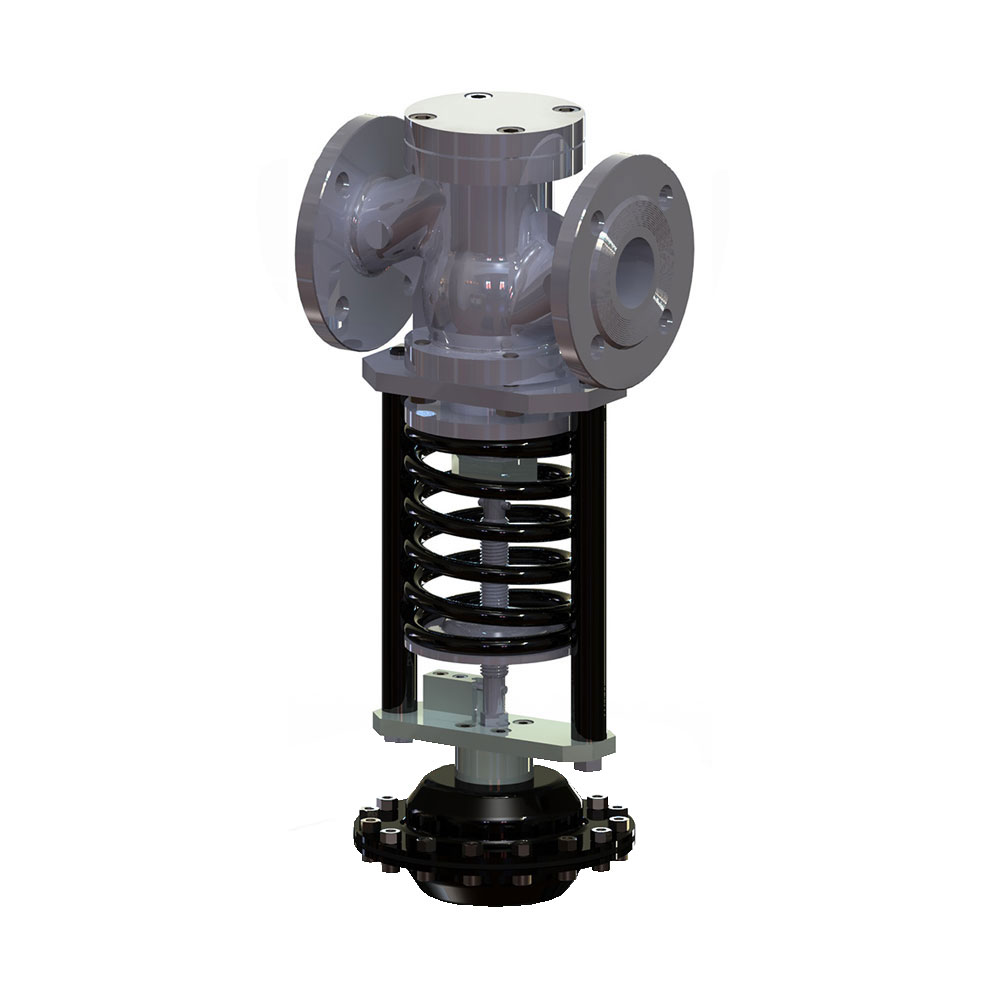 S1 excess pressure valveDiaphragm and bellows, up to DN150 and 220 °C.
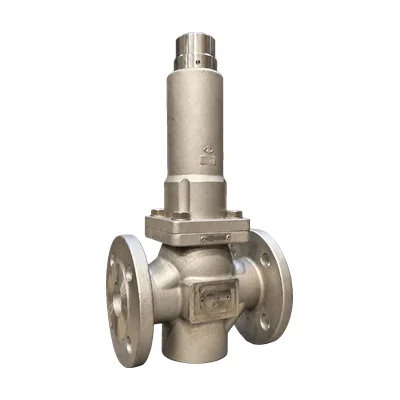 S3 relief valveSpring-loaded, up to DN150 and 20 barg set pressure.
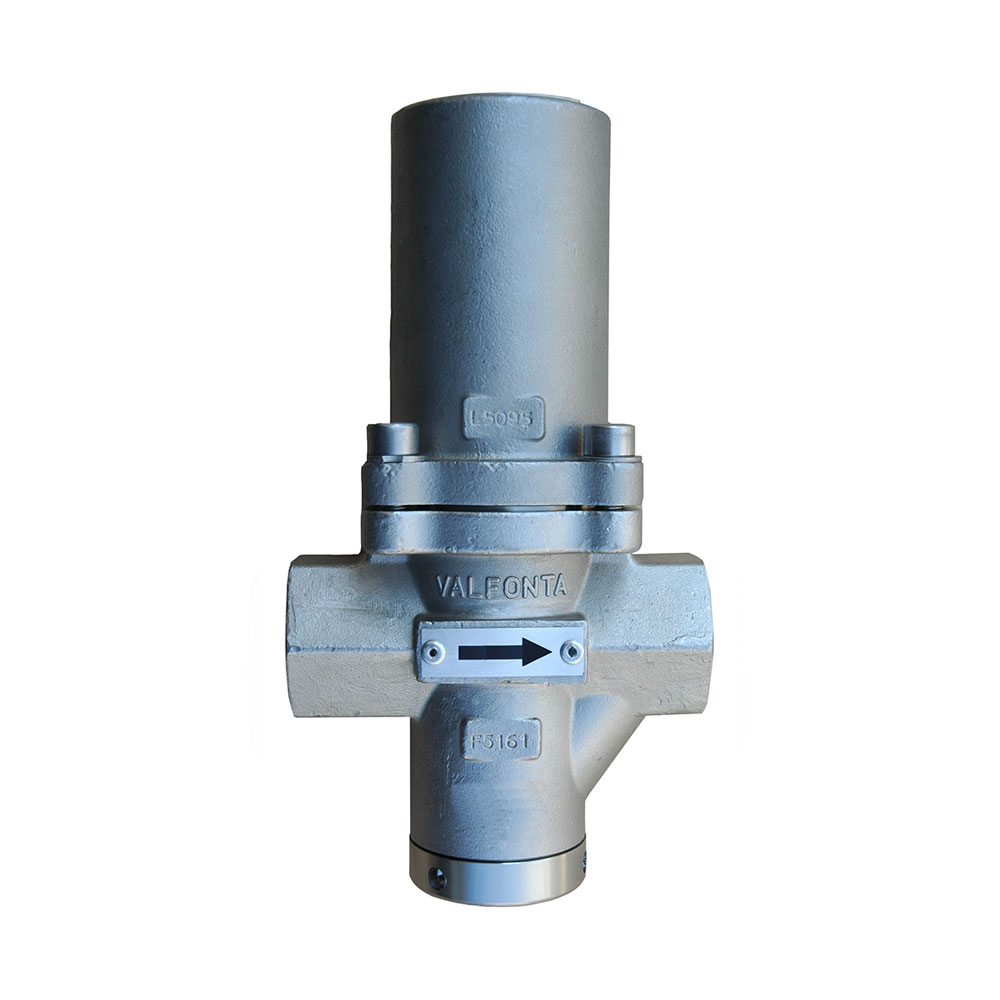 PRV53 excess pressure valveCF3M stainless, DN15 to DN25, set pressure from 0.5 to 15 barg.
- PRV54 excess pressure valveCF3M stainless, DN15 to DN25, steam up to 210 °C.
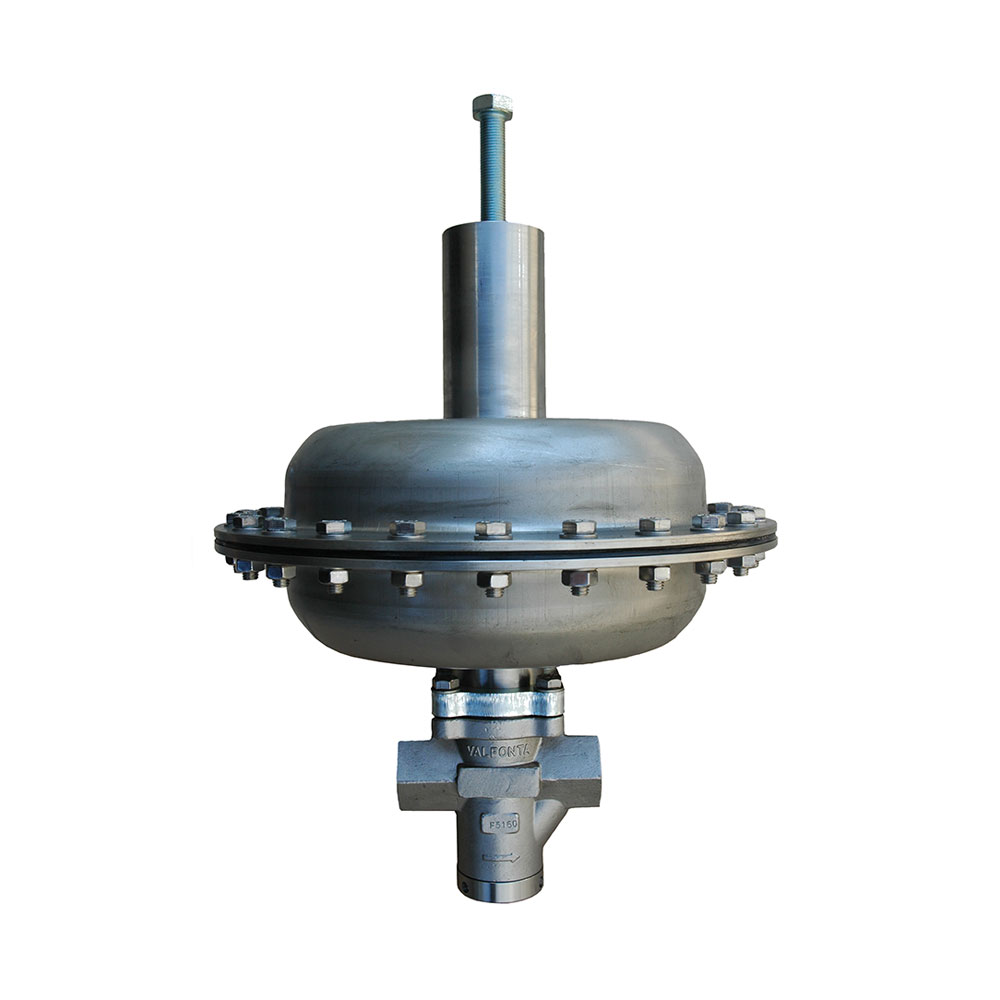 PRV55 excess pressure valveSet pressures from 0.01 barg, DN15 to DN25.
Request a quote for the S2
Give us your installation details and we will recommend the right size, Kv, actuator, and diaphragm for your set pressure.
- Fluid and operating temperature
- Set pressure and normal operating pressure
- Flow rate the valve must discharge
- Size, body material, and connection type
You can also call 933 720 888.