


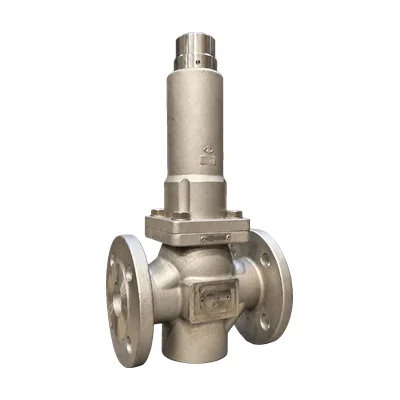

Technical comparison: piston vs. diaphragm reducing valves
Article contents
Which actuation system best suits your process?
The choice between a piston and a diaphragm pressure reducing valve (M1 Series) should not be based on the initial cost, but on the allowable hysteresis and the nature of the fluid.
Both technologies perform the function of reducing a variable inlet pressure (P1) to a constant outlet pressure (P2), but they do so through radically different force mechanics.
While the piston stands out for its mechanical robustness in general service lines, the diaphragm offers far superior regulation accuracy in critical processes. Below, we analyze the physical variables that determine the “best fit” for your installation.
What sets the sensitivity of the M1 Series (diaphragm) apart from a piston PRV?
The fundamental difference lies in static and dynamic friction. In a piston reducing valve, the tightness of the balancing mechanism depends on O-rings or sealing rings that slide against the cylinder walls.
This friction creates a significant dead band: the piston needs a larger pressure change to overcome the initial friction and start moving. In contrast, the Valfonta M1 Series uses a large-diameter elastomeric diaphragm.
No sliding friction: Since there are no rubbing parts in the sensing element, the response to downstream pressure variations is almost instantaneous.
Actuating surface: The diaphragm offers a much larger effective area than a piston. According to the formula Force = Pressure × Area, a small fluctuation in the outlet pressure generates a large corrective force on the stem.
Operating result: The M1 Series can maintain the set point pressure with deviations below ±5-10%, while a standard piston system can fluctuate by ±10-20%, depending on seal wear.
When is the piston the only viable option due to pressure limits?
The diaphragm is a sensitive element with physical limits on burst resistance. Although our diaphragms are reinforced with intermediate fabric mesh, they cannot compete with the structural integrity of a solid metal piston in very high-pressure scenarios.
We recommend choosing piston technology (PRV models) in the following situations:
Extreme inlet pressures: When P1 exceeds 25 bar (the usual limit of the M1 Series in large sizes) or reaches 40-50 bar.
Risk of water hammer: In hydraulic networks with violent pump start-ups or fast closing of downstream valves, transient overpressure peaks can tear a diaphragm. The piston, due to its mass and inertia, better absorbs these mechanical shocks without suffering catastrophic damage.
Static applications: If the valve is to remain closed for long periods under high static pressure, the piston suffers less plastic deformation (creep) than an elastomer.
How does fluid “dirtiness” affect the maintenance of each system?
Fluid quality is the factor most often overlooked in the specification and the main cause of premature failure.
Piston valves: They are extremely sensitive to particles. A metal chip, foundry sand, or limescale deposits can lodge between the piston and the liner. This causes the actuator to “seize” or scratches the sealing surfaces, resulting in constant internal leakage. They must have a fine-mesh Y-strainer upstream.
Diaphragm valves (M1 Series): They are much more tolerant of fluids with suspended solids or slightly dirty fluids (instrument air with oil, unfiltered industrial water). Since there is no tight mechanical fit (clearance) as in the piston, particles do not block the movement of the actuator.
How do they respond to the thermodynamic demands of the plant?
Beyond the pressure rating, the dynamic behavior of the valve in response to demand variations is what defines process stability.
At Valfonta, we have put both designs through bench testing under variable flow conditions. The conclusion is clear: the mass of the moving element determines the inertia of the system.
Which technology offers greater stability under sudden flow changes?
In batch processes (e.g., autoclave start-ups, batch heat exchangers), the demanded flow swings violently from 0 to 100%.
The M1 Series (Diaphragm) stands out here for its low inertia. With a stem attached to a large-area flexible diaphragm, any fall in pressure in the outlet line causes an immediate and proportional opening.
The piston, by contrast, suffers from greater friction (hysteresis). This can cause the valve to be “slow” to open in response to a sudden demand for steam, producing a momentary pressure dip (droop) that is unacceptable for precision processes.
Below, we compare the operating parameters of both technologies:
| Critical parameter | Piston reducing valve (PRV Series) | Diaphragm reducing valve (M1 Series) |
|---|---|---|
| Regulation accuracy | Standard (±10% to ±20%) | High Accuracy (±5% to ±10%) |
| Response sensitivity | Medium (Seal friction) | High (No sliding friction) |
| Pressure range for P2 | Wide (Up to 20-25 bar or more) | Limited (0.05 to 15 bar max.) |
| Resistance to impurities | Low (Risk of seizing) | High (Tolerates fine particles) |
| Ideal application | General lines, air, raw water | Process steam, pure gases, fine regulation |
Is steam temperature decisive for the service life of elastomers?
Yes, temperature is the limiting factor of the diaphragm design. While a piston reducing valve with a metal-to-metal seat or graphite seals can withstand temperatures of 300°C or higher, elastomers have an irreversible thermal degradation point.
At Valfonta, we use specially formulated compounds:
EPDM (Ethylene Propylene): Standard for saturated steam up to 180°C – 200°C. It offers excellent elasticity and resistance to aging from moist heat.
FKM (Viton): Superior chemical resistance, but in continuous steam applications it can undergo hydrolysis if the correct grade is not selected.
If your process involves high-temperature superheated steam, the diaphragm is not a viable long-term option due to crystallization of the rubber, which eventually cracks from fatigue. In that scenario, the robustness of the piston or the use of control valves with a positioner (C1 Series) is mandatory.
Why does Valfonta’s “balanced” design make the difference?
A classic problem in simple reducing valves is that variations in the inlet pressure (P1) alter the outlet pressure (P2) due to the unbalanced forces on the plug.
To solve this, the engineering of the M1 Series incorporates a pressure balancing system:
- Stainless steel bellows: In small sizes, a bellows isolates the stem and balances the forces, making the valve “blind” to upstream fluctuations.
- Balancing plunger (DN65 – DN100): In large sizes, we integrate a balancing plunger that cancels the axial thrust generated by P1.
Thanks to this design, even if the boiler pressure fluctuates between 6 and 10 bar, your process line will stay locked at the 4 bar set point, ensuring the repeatability of the production batch.
What are the implications of the PED Directive 2014/68/EU for the choice?
Safety in process plants is non-negotiable, and the selection of the reducing valve has direct implications for compliance with the Pressure Equipment Directive 2014/68/EU (PED). Although both technologies are safe if properly maintained, the failure mode differs substantially.
A piston valve, due to its robust metal construction and thick walls, has a lower risk of housing rupture under extreme overpressure, which makes it the preferred option for high-pressure steam lines classified in fluid Group 2.
However, its tendency to leak internally due to seal wear can silently pressurize the low-pressure section, requiring full-lift safety valves to be installed downstream.
On the other hand, M1 Series diaphragm valves require a more rigorous inspection protocol under the regulations. Since the diaphragm is a flexible element subject to cyclic fatigue, there is a theoretical risk of rupture.
To mitigate this in critical applications with Group 1 hazardous fluids, Valfonta designs its equipment with safety chambers and double-layer stainless steel bellows that act as a secondary barrier. This ensures that, even in the unlikely event of a diaphragm collapse, the fluid is not released to the atmosphere, protecting operators and meeting fugitive emissions requirements.
Why validate the calculation with the technical office before purchasing?
The most expensive mistake in fluid engineering is selecting a valve based solely on the diameter of the existing pipe, ignoring the thermodynamics of the change of state. Buying a reducing valve without first calculating the flow coefficient (Kv) and the fluid velocity often results in oversized equipment operating in the “wire-drawing zone” (openings below 5%), generating noise, cavitation, and premature wear that no warranty covers.
At the Valfonta technical office, we do not just process order codes; we audit the application. To secure the return on your investment, our engineering team needs to analyze the actual mass flow, the differential pressure, and the operating temperature.
With this data, we will determine whether your process requires the surgical precision of an M1 Series diaphragm valve or the battle-tested robustness of a piston PRV, delivering a certified solution, calibrated on a test bench and ready to operate with complete reliability from the very first minute.
Valfonta diaphragm reducing valves
| Model | Sizes | Max. inlet | Outlet | Max. temperature | Kv (m³/h) |
|---|---|---|---|---|---|
| PRV45 | DN15 to DN25 | 16 barg | 0.01 to 8 barg | −10 to 150 °C; steam up to 150 °C | 2 to 3.5 |
| M2 | DN15 to DN100 | 40 barg (25 from DN65) | 0.02 to 10 barg | 180 °C with PTFE and condensate pot | 3.5 to 115 |
| M1 | DN15 to DN150 | 40 barg (25 from DN65) | 0.1 to 15 barg | 220 °C with condensate pot | 3.5 to 240 |
Data from the datasheets. The M2F is not a diaphragm valve but a bellows valve: from DN15 to DN50, outlet from 1 to 10 barg, and steam up to 200 °C without a condensate pot.
Control line and condensate pot
The M1 always works with an external control line made of 10 × 1 mm tubing. The M2 and the PRV45 come with internal pressure sensing as standard; on steam, they need external sensing. The control line is connected in the reduced-pressure zone, at least 1 m from the valve outlet, or to the manifold if there is one. If the valve oscillates, a needle valve can be added.
With steam or with liquids above 125 °C, the M1 and the M2 need a condensate pot (water seal pot): a water-filled vessel that protects the diaphragm from direct contact with the hot fluid. It goes at the highest point of the control line, connected from the side and with a slight slope toward the pipe. On the PRV45, the condensate pot is needed above 120 °C.
The actuator is mounted facing down, which is the standard position and the one required for steam; facing up, only with gases and liquids up to 80 °C, and never horizontal. Remember that a reducing valve is not a safety valve: if the installation requires it, fit overpressure protection at the outlet. More details in how to install a pressure reducing valve and how to adjust a reducing valve.
Frequently asked questions
What is the difference between a pressure reducing valve and a pressure stabilizing valve?
In practice, both names are used for the same function: keeping the downstream pressure stable even when the inlet pressure or the flow varies. If what you need is to maintain the upstream pressure, the right valve is a pressure relief or excess pressure valve.
What is the minimum pressure a diaphragm reducing valve can regulate?
With the PRV45, 10 mbar (0.01 barg), with the 295 mm actuator. The M2 regulates from 0.02 barg in DN15 to DN32.
When is the condensate pot needed?
On the M1 and the M2, with steam and with liquids above 125 °C; on the PRV45, above 120 °C. It protects the diaphragm from the hot fluid and is filled with water before start-up.
Can I mount the actuator facing up?
Only with gases and liquids up to 80 °C. With steam, the actuator always faces down, and it must never be horizontal.
Do diaphragm reducing valves have an ATEX version?
Yes. The M1, the M2, and the PRV45 carry ATEX II 2 GD marking (certificate LOM 14.034 U) for zones 1, 2, 21, and 22, depending on the temperature class of the fluid. See our certificates.
Related valves
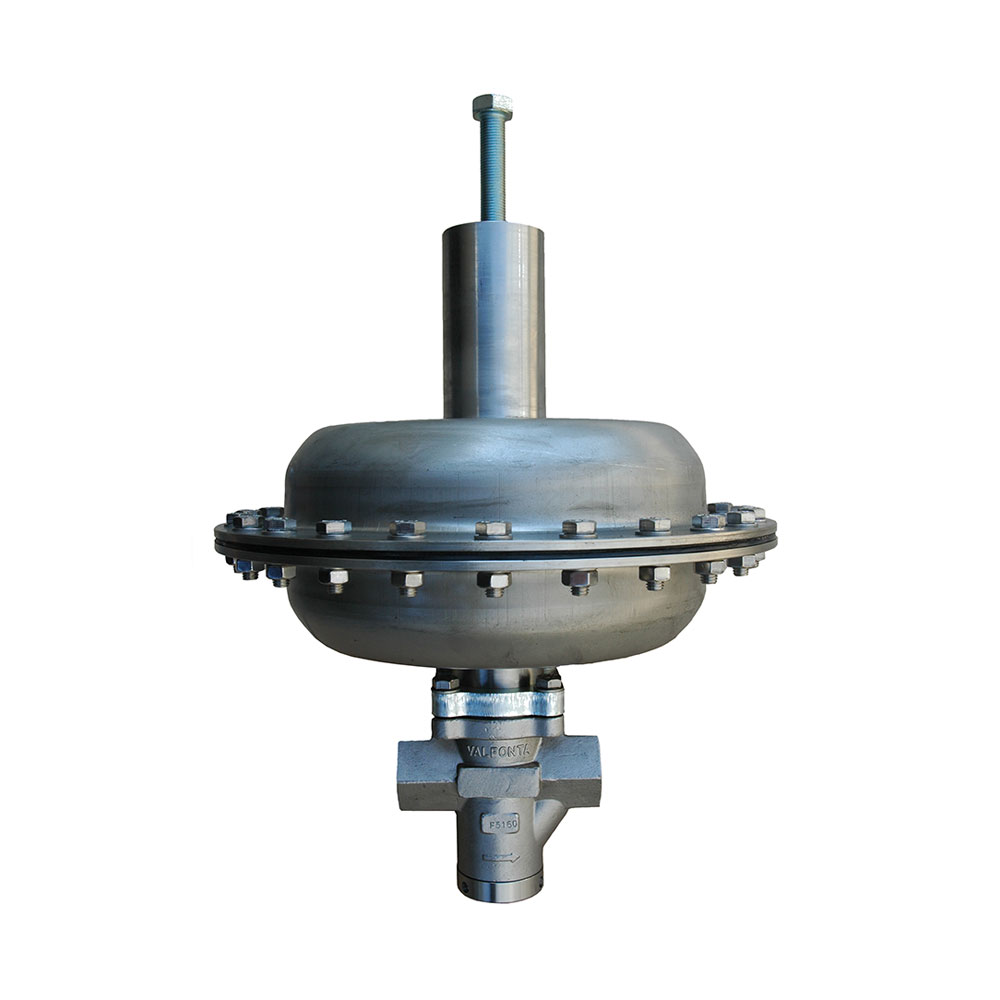 PRV45 reducing valve
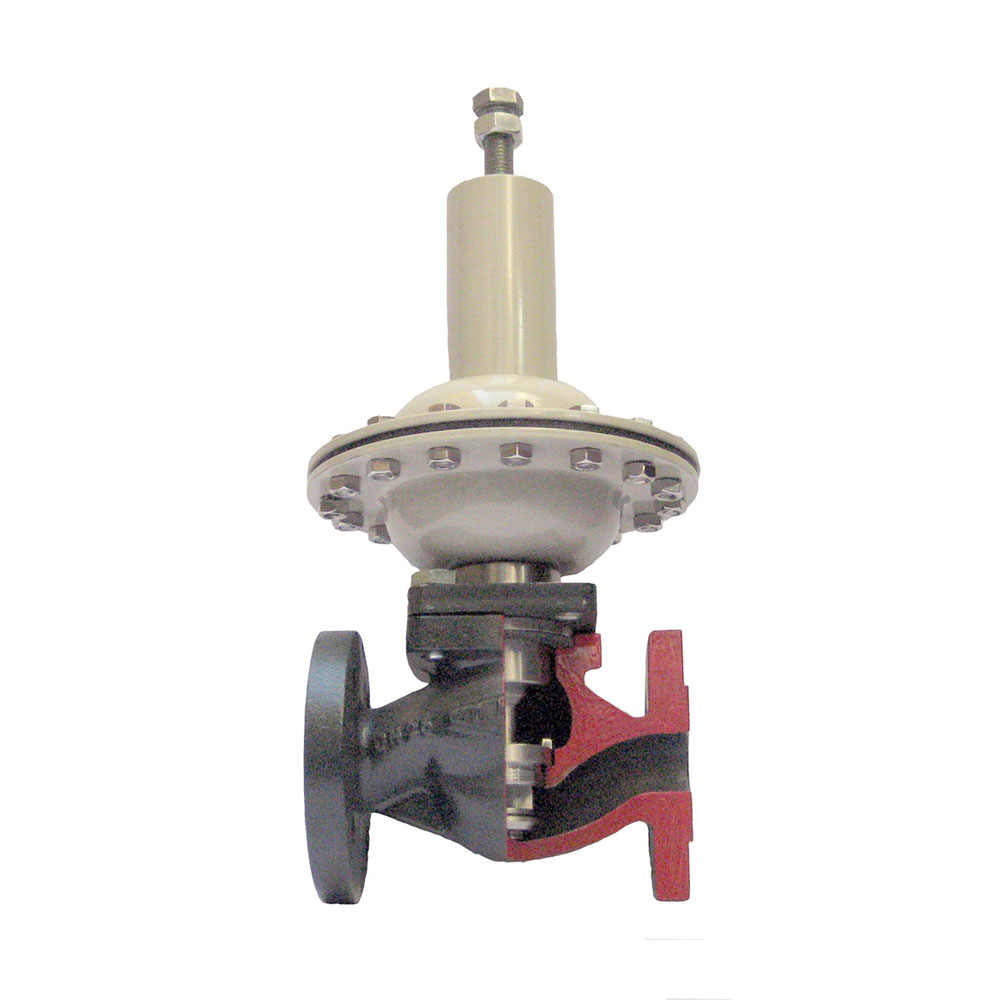 M2 diaphragm reducing valve
Related articles
Can we help with your installation?
Tell us the fluid, the inlet and outlet pressures, the temperature, and the flow rate, and we will recommend the right valve.
You can also call 933 720 888 or email valfonta@valfonta.com.