


Valfonta pressure relief valves for fire protection
Article contents
Valves designed to relieve pressure and ensure the safety of the system and its users against a possible fire
In this post we will try to clarify and explain in detail all the features of fire protection pressure relief valves, also called Relief Valves.
These valves are installed to prevent overpressure in a system or installation when the pump reaches 110% of the motor’s operating speed, or in other words, 121% of the pump’s churn or shutoff pressure—the term used for the pressure at zero flow of the valve—. The general criteria for water networks are in our guide to the pressure relief valve for water.
Its main function is to prevent overpressure in the fire protection system caused by overspeed.
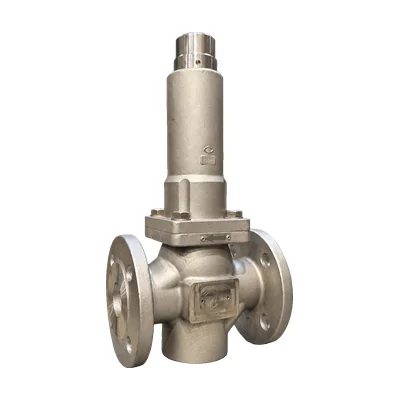
Our fire protection pressure relief valves: the S3 model
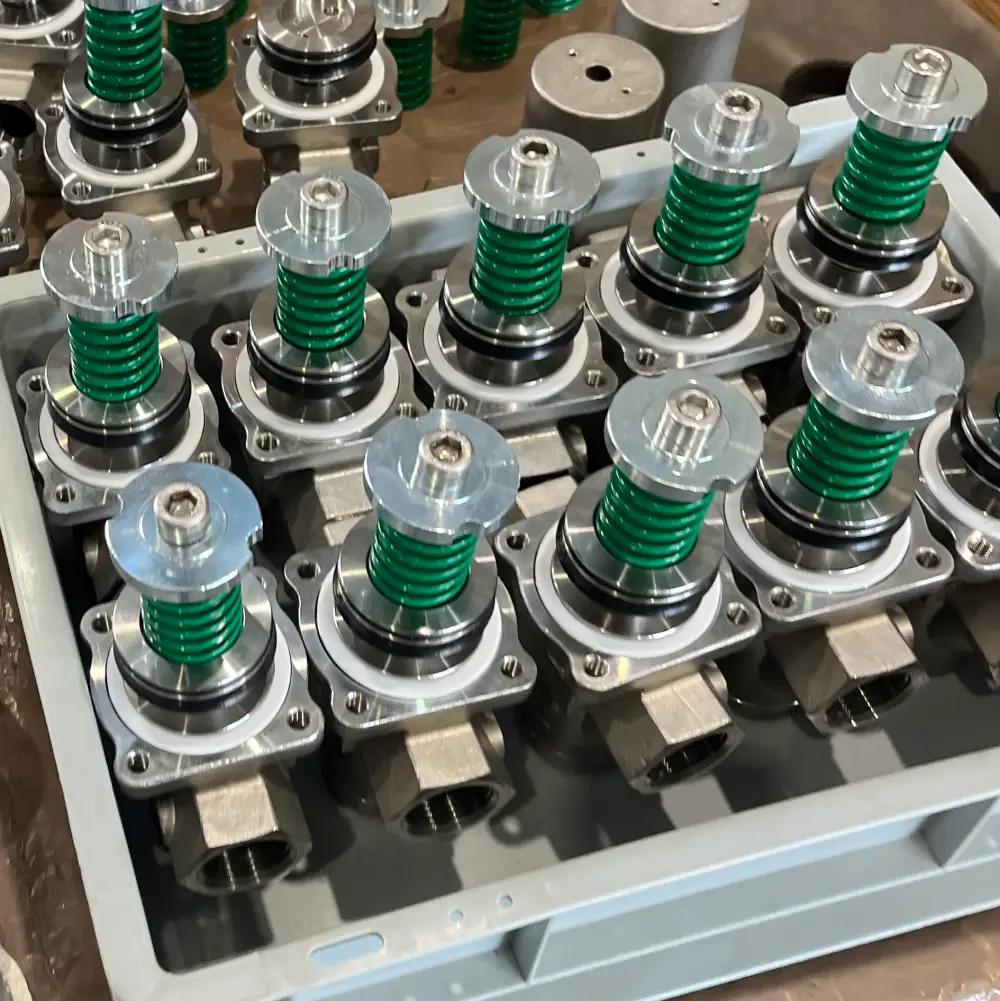
The S3 fire protection pressure relief valve works on the direct-acting principle. That is, when the force resulting from the inlet pressure exceeds the setting force of the spring, the valve opens in proportion to the change in pressure.
This spring force is adjusted by means of a special adjusting screw fitted on the valve.
Some of our pressure relief valves
It is a model regulated under the ISO 9001 quality system; it must be handled, transported, and stored with care.
The most important thing is to protect the valve from adverse external agents such as dirt, moisture, and extreme temperatures.
It is important to remember that the valves may be too heavy to move by hand; in that case, suitable lifting attachments should be used on the valve body, and it is not at all advisable to attach them to sensitive parts of the valve such as the adjusting screws.
Other features worth mentioning about this fire protection pressure relief valve are that the internals are made of AISI 316L stainless steel, it has a guided plug for greater flow stability, a set pressure ranging from 0.5 to 20 barg, and it is suitable for liquids, gases—Group 1 and 2—and steam.
To adjust the set pressure, unscrew the cap, carefully remove the O-ring, and turn the adjusting stem clockwise to increase the set pressure, or counterclockwise to decrease it.
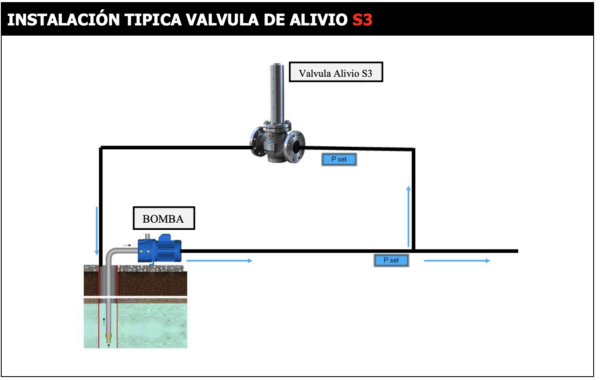
Where the relief valve is installed in a fire pump set
The relief valve is mounted on a branch line off the pump discharge that returns to the suction or to the tank, with a pressure gauge upstream. While the pressure is below the set pressure, it remains closed. If the pressure exceeds it, the S3 opens in proportion to the pressure rise, returns the excess flow, and closes again when the pressure returns to normal.
- Pump or equipment that generates the pressure.
- Pressure gauge, to check the operating pressure and the opening pressure.
- Relief valve, on the branch line.
- Discharge to the suction or the tank.
- Protected piping network and equipment.
A strainer should be installed ahead of the valve, and the piping should be cleaned before installation, to protect the seat. The recommended position is in horizontal piping, following the arrow on the body.
Features of the S3 valve
| Feature | Value |
|---|---|
| Principle | Direct-acting, spring-loaded, with guided plug |
| Sizes | DN15 to DN100; DN125 and DN150 on request |
| Set pressure | 0.5 to 20 barg, with different spring ranges |
| Pressure rating | PN16 – PN25 – PN40 · ANSI Class 150 – 300 |
| Kv | From 3.5 m³/h (DN15) to 130 m³/h (DN100) |
| Leakage class | IV (metal-to-metal) or VI (PTFE + graphite seat) |
| Body | GP240GH carbon steel or A351 CF3M stainless; on request, RG10 bronze, duplex, or super duplex |
| Internals | Stainless steel AISI 316L |
| Connections | EN and ANSI flanges · BSP or NPT thread from ½″ to 2″ |
| Options | Handwheel adjustment · special plugs and gaskets |
Data from the S3 manual and datasheet.
Set pressure and checks
Valfonta supplies the valve adjusted to the set pressure specified in the order. If it needs to be corrected, remove the cap (15) and the O-ring (16) and turn the adjusting stem (13): turning it clockwise compresses the spring and increases the set pressure; counterclockwise, it decreases. With the handwheel option, simply turn the handwheel. Then refit the O-ring and the cap.
At start-up, open the isolation valves slowly, the inlet valve first, to avoid water hammer. Periodically check that the valve opens at the intended value: we explain this in why you should audit the set pressure of relief valves. An oversized valve tends to open and close abruptly; see chattering in relief valves.
The S3 has specific approval for fire protection installations. If your project requires it, ask us for the certificate with the quote and tell us which regulations the installation must meet. In addition, it is manufactured under an ISO 9001 quality system and, depending on size and pressure, under module D1 of the Pressure Equipment Directive: see certificates.
If you are comparing models, our pressure relief valves page has the table with the seven models in the range.
Feel free to ask us for personalized advice on choosing your fire protection pressure relief valve
We have spent many years working as manufacturers of pressure relief, pressure reducing, control, and safety valves. We also have a dedicated line of steam and liquid ejectors and injectors.
If you are not familiar with aspects such as how they work, their terminology, or their technical applications, components of this type can be somewhat difficult to choose.
To receive direct, personalized advice from one of our specialized technicians, simply fill out our contact form. You can also call us at 933 72 08 88 or email us at valfonta@valfonta.com.
We will answer all your questions, provide detailed and valuable information, and guide you throughout the selection process. This is, without a doubt, one of the most important parts of our daily work.

Frequently asked questions
What is a relief valve on a fire pump for?
To prevent the network pressure from exceeding the set value when the pump runs at low flow or overspeed. The valve opens, returns the excess flow to the suction or to the tank, and closes when the pressure returns to its value.
What set pressure range does the S3 have?
From 0.5 to 20 barg, with different springs. In DN15 and DN20, for example, the standard ranges are 1 to 6, 4 to 12, and 8 to 16 barg; the 15 to 25 barg range is available on request.
Does a relief valve replace a safety valve?
No. The relief valve opens proportionally to maintain the pressure; it is not a safety accessory. If the installation needs overpressure protection, a safety valve must also be installed. See the difference between a safety valve and a relief valve.
Is the S3 approved for fire protection installations?
Yes, it has specific approval for fire protection. Ask us for the certificate along with the quote.
What seat do I need if I want full tightness?
The S3 offers leakage class IV with a metal-to-metal seat and class VI with a PTFE + graphite seat.
What information should I send to order the valve?
The fluid and its temperature, the set pressure and the normal operating pressure, the flow it must relieve, the size, the body material and the connection type, and the regulations the installation must meet. You can send them via contact.
Related valves
- S3 pressure relief valveFrom DN15 to DN150, PN40, set pressure up to 20 barg and 220 °C.
 Pressure reducing valvesValfonta pressure reducing valves: 8 models from DN8 to DN150 and up to 40 bar for steam, water, air, and gases.
 Control valvesValfonta C1 control valve: globe valve with pneumatic actuator, DN15 to DN100, PN40, and Kv up to 130 m³/h.
Related articles

Can we help with your installation?
Tell us the fluid, the inlet and outlet pressures, the temperature, and the flow rate, and we will recommend the right valve.
You can also call 933 720 888 or email valfonta@valfonta.com.