


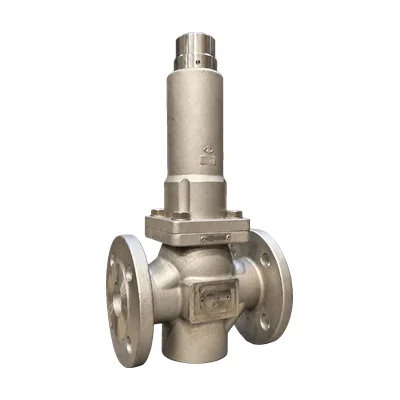

Complete valve guide: reducing, relief, and more
Article contents
Let’s begin our guide to industrial valves
Industrial valves are essential components in any system that involves conveying, regulating, or containing pressurized fluids.
In this technical guide, we explore the main types of valves used in industry—pressure reducing valves, relief valves, and control valves—explaining their functions, characteristics, and most common applications.
We will also detail the models developed by Valfonta, a manufacturer with more than 50 years of experience, and its recommendations for each type of installation.
This guide takes an informative and practical approach, intended for engineers, maintenance managers, plant managers, and process technicians looking for a clear and useful reference for industrial valve selection.
What is an industrial valve and what functions can it perform?
An industrial valve is a mechanical device designed to control the passage of a fluid (liquid, gas, or steam) through a piping system. Depending on its design and operating principle, it can perform several key functions in an installation:
- Regulate the pressure of the system, keeping it constant upstream or downstream.
- Open or close the flow path manually or automatically (shutoff function).
- Divert the flow between two or more lines (three-way or diverter valves).
- Release excess pressure when a maximum value is reached (relief or safety function).
Valves are essential to ensure:
- The safety of the system and equipment.
- The continuity and stability of the industrial process.
- Energy efficiency and the service life of components.
They can also be manually operated or operated by automatic actuators (pneumatic, electric, or hydraulic), depending on the level of control required.
Pressure reducing valves
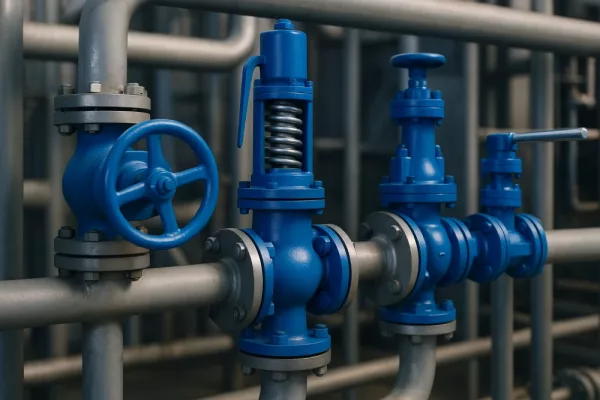
Pressure reducing valves are devices that keep the outlet pressure constant, even if the system’s inlet pressure varies. They are a very common solution in circuits where sensitive equipment needs to be protected or the pressure must be adapted to different sections of the installation.
How does a reducing valve work?
These valves act automatically and proportionally: when the inlet pressure is higher than the set point, a spring and diaphragm (or piston) system restricts the fluid flow to maintain the desired pressure at the outlet.
They require no external power (they are self-operated) and work through a balance of forces between the spring and the fluid pressure.
When and why should you use a reducing valve?
- When the main line pressure is higher than needed in a specific area.
- To protect equipment or piping that cannot tolerate high pressures.
- In circuits with frequent pressure variations, but where a stable outlet is required.
- To ensure safety and energy efficiency.
Common application examples
- Steam systems, to reduce pressure before it enters heat exchangers.
- Drinking water or industrial cooling networks.
- Compressed gas or technical fluid lines in laboratories and industrial processes.
Featured Valfonta reducing valve models
M series: M1 and M2 valves
The M1 and M2 valves are self-operated pressure regulators, especially rugged and versatile. They feature a guided plug and a pressure chamber with a reinforced diaphragm. They require no auxiliary power and provide reliable, stable regulation.
- Pressure range: from 0.1 to 15 barg.
- Operating temperature: up to 220 °C with EPDM + PTFE diaphragm
- Materials: body in stainless steel, carbon steel, or bronze.
Typical applications: steam, compressed air, technical gases, industrial water.
These valves are ideal for applications that demand reliability, precision, and low maintenance.
PRV series: PRV20, PRV30, PRV44, PRV45
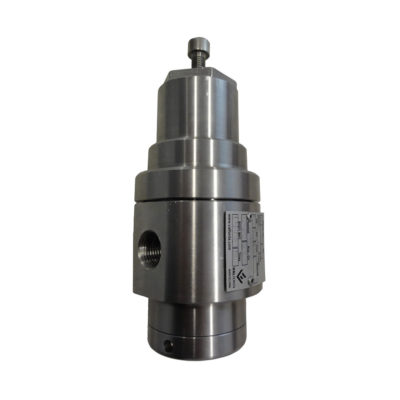
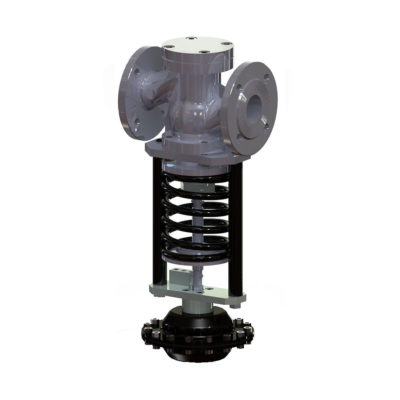
The PRV range offers compact, self-regulating, balanced valves with a modern, high-efficiency design.
- Pressure range: 0.01 to 10 barg (depending on model).
- Maximum inlet pressure: up to 25 bar.
Connections: BSP/NPT threaded, DIN or ANSI flanges. - Body: AISI 316L stainless steel or industrial bronze.
- Applications: laboratories, compressed air, nitrogen, sanitary plants, inert gases.
These models stand out for their adaptability and ease of installation in tight spaces.
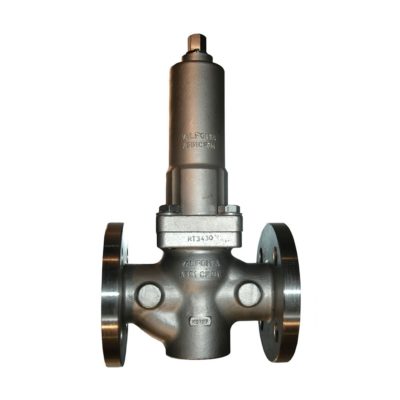
VD model
The VD valve is a self-operated pressure reducing valve designed especially for gases and steam.
- Pressure range: from 0.01 to 8 barg
- Compact design with top-mounted pneumatic actuator.
- Material: stainless steel or bronze, depending on the application.
- Installation: easy integration into horizontal lines.
It is an excellent option for steam installations, technical gases, or thermal processes with limited space.
Pressure relief valves
Pressure relief valves—also known as excess pressure valves—are designed to release pressure automatically when it exceeds a given set value. Their main function is to protect the installation against occasional overpressures that could damage components or compromise system safety.
Unlike reducing valves, they do not act continuously; instead, they remain closed until the inlet pressure reaches the defined threshold.
How does a relief valve work?
When the upstream pressure exceeds the set point, the valve opens proportionally and releases fluid until the pressure is back within the acceptable range.
Once equilibrium is restored, the valve closes automatically thanks to the action of the adjusting springs.
These valves should not be confused with safety valves, which usually open more abruptly and are intended for emergency situations.
When should you use a relief valve?
- When it is necessary to protect tanks, heat exchangers, pumps, or boilers from possible overpressure.
- In systems where transient pressure spikes can occur due to external causes (valve closure, pump startups, etc.).
- As a complementary measure to reducing valves or control valves.
Common application examples
- Steam and compressed air systems.
- Sanitary or gas installations.
- Chemical or pharmaceutical plants.
Featured Valfonta relief valve models
S1
- Self-operated, no auxiliary power.
- For steam, air, gases, and liquids.
- Set pressure: 0.1 to 15 barg.
- Body available in stainless steel and carbon steel; bronze on request.
S2
- High sensitivity and precise response.
- Set pressure range: 0.02 to 10 barg.
- Connections: DIN and ANSI flanges, BSP/NPT threads.
- Ideal for systems with frequent pressure variations.
S3
- Guided plug, metal or soft seat leakage class.
- Pressure adjustable up to 20 barg.
- Materials resistant to high temperatures (up to 220 °C).
- Recommended for steam, aggressive fluids, and industrial gases.
PRV53
- Compact valve for inert gases and liquids.
- Maximum pressure: 10 barg.
- AISI 316L stainless steel body.
- Threaded or flanged connections.
PRV54
- High thermal resistance (up to 210 °C).
- Suitable for steam, gases, and superheated water.
- Bellows-balanced, ideal for continuous duty.
PRV55
- Rugged model, made entirely of stainless steel.
- Set pressure range: 0.01 to 8 barg.
- Easy to adjust, maintenance-free.
- Recommended for sanitary installations and laboratories.
Comparison table of industrial valve types
| Valve types | Main function | Typical applications | Recommended models |
|---|---|---|---|
| Pressure reducing valves | Maintain a constant downstream pressure | Steam, compressed air, industrial water | M1, M2, PRV20, PRV44, VD |
| Pressure relief valves | Release pressure when it exceeds the set threshold | Boilers, pressurized systems, gases, and steam | S1, S2, S3, PRV53, PRV54, PRV55 |
| Control valves | Dynamically adjust pressure, flow, or temperature | Automated processes, industrial fluid control | C1 |
Fluid type
- Liquid, gas, or steam: each type of fluid has different properties that affect the choice of materials and design.
- Special characteristics: presence of particles, chemical aggressiveness, viscosity, purity, etc.
Operating pressure
- What are the inlet pressure and the desired outlet pressure?
- Are there pressure spikes or frequent variations?
- At Valfonta, we offer valves that cover wide ranges, from very low pressures (0.01 barg) to solutions for 25 barg, depending on the model.
Operating temperature
- It is essential to choose diaphragm and plug materials that can withstand the fluid temperature.
- We offer solutions with PTFE, EPDM, or graphite gaskets, capable of operating at up to 220 °Cmanual-S1-18A-ESP
Regulatory requirements
- In sectors such as chemicals, food, or pharmaceuticals, compliance with regulations such as PED 2014/68/EU or ATEX for explosive zones may be required.
- Most of our valves include CE and ATEX certifications, depending on the model.
Connections and available space
- Availability of DIN/ANSI flanges or threaded connections (BSP/NPT).
- Compact design (such as the PRV models) or standard configurations for easy maintenance.
Maintenance and spare parts
- Valves such as the M1, S1, or PRV55 are designed to make inspection and component replacement easier, reducing downtime costs and extending system service life.
Related valves
 Control valves
Related articles

Can we help with your installation?
Tell us the fluid, the inlet and outlet pressures, the temperature, and the flow rate, and we will recommend the right valve.
You can also call 933 720 888 or email valfonta@valfonta.com.