
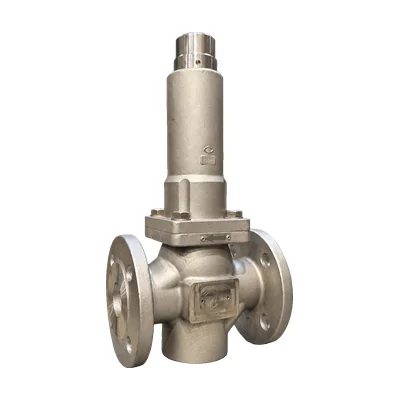

Pressure reducing valve · Direct-acting
PRV20 pressure reducing valve
316L stainless
Self-regulating, piston-balanced reducing valve with AISI 316L stainless steel body and internals and threaded connection from ¼″ to ¾″. It keeps the outlet pressure constant even when the inlet pressure fluctuates, with up to 40 barg upstream.
- Sizes¼″ to ¾″ DN8 to DN20
- Pressure ratingPN40
- Inlet pressureup to 40 barg
- Outlet pressure0.2 to 20 barg
- Temperature−20 to 150 °C with Viton gaskets
- Kv1.2 to 2.4 m³/h
Configure your valve
Questions about sizing? Call 933 720 888 or email valfonta@valfonta.com.
- In-house design and manufacturing in Badalona
- ATEX II 2 GD marking for zones 1 and 21
- Installation in any position
- Genuine spare parts available
What the PRV20 is used for
The PRV20 is the smallest pressure reducing valve in the Valfonta range: it covers ¼″ to ¾″ with BSP or NPT threaded ends. It is direct-acting, with no auxiliary power: an adjusting spring and the outlet pressure itself balance the piston, and the valve closes when the downstream pressure rises above the set value.
It accepts up to 40 barg inlet pressure and offers three outlet ranges, from 0.2 to 20 barg, which makes it useful on small-diameter lines with high inlet pressures. The body and internals are AISI 316L stainless steel, and it requires no periodic maintenance. If you are looking for a stainless steel reducing valve, also compare the PRV30 and the PRV44.
- Chemical laboratoriesSupplying laboratory equipment and installations with stable pressure.
- Sanitary plantsWater and fluid lines where 316L stainless steel is required.
- Compressed airReducing the network pressure to the value each point of use requires.
- Sprinkler systemsPressure stabilization in sprinkler installations.
- Group 2 liquids and gasesWater, oil, and non-flammable gases such as nitrogen.
- Desalination plantsSolid bar stock 316L for sampling and analyzer lines in coastal plants: stainless steel PRVs for desalination plants.
PRV20 technical specifications
| Type | Self-regulating, direct-acting, piston-balanced pressure reducing valve |
|---|---|
| Sizes | ¼″, ⅜″, ½″, and ¾″ (DN8 to DN20) |
| Connections | BSP or NPT thread (others on request) |
| Pressure rating | PN40 |
| Maximum inlet pressure | 40 barg |
| Outlet pressure ranges | 0.2 – 2 barg · 1 – 8 barg · 5 – 20 barg (depending on spring) |
| Kv coefficient | 1.2 m³/h (¼″) · 1.8 m³/h (⅜″) · 2.1 m³/h (½″) · 2.4 m³/h (¾″). Special Kv on request |
| Temperature | −20 to +150 °C (with Viton gaskets) |
| Fluids | Group 2 liquids and gases: water, oil, compressed air, and non-flammable gases |
| Materials | Body and internals in AISI 316L (1.4404) stainless steel |
| Gaskets | NBR, FKM, or EPDM (special materials on request) |
| Mounting position | Any position |
| Pressure Equipment Directive | PED 2014/68/EU: CE marking not required |
| ATEX | II 2 GD c IIC Tx / c IIIC TxºC · certificate LOM 14.034 U |
| On request | Duplex or super duplex body · weld ends · other connections · special Kv · special gaskets |
Dimensions and weight
| ¼″ | ⅜″ | ½″ | ¾″ | |
|---|---|---|---|---|
| Kv (m³/h) | 1,2 | 1,8 | 2,1 | 2,4 |
| Length A | 80 | 80 | 80 | 80 |
| Height H1 | 110 | 110 | 110 | 110 |
| Height H2 | 150 – 180 | 150 – 180 | 150 – 180 | 150 – 180 |
| Weight (kg) | 3,5 | 3,5 | 3,5 | 3,5 |
Dimensions in millimeters. The dimensioned drawing is in the PDF datasheet.
Exploded view and materials (19 parts)
| No. | Part | Material |
|---|---|---|
| 1 | Bottom cover | Stainless steel 1.4404 (316L) |
| 2 | O-ring | NBR |
| 3 | Seat | NBR |
| 4 | O-ring | NBR |
| 5 | Body | 1.4404 (316L) |
| 6 | O-ring | NBR |
| 7 | Piston | 1.4404 (316L) |
| 8 | Washer | Stainless steel A2-70 |
| 9 | Spring washer | 1.4404 (316L) |
| 10 | Adjusting screw | Stainless steel A2-70 |
| 11 | Nut | Stainless steel A2-70 |
| 12 | Spring cover | 1.4404 (316L) |
| 13 | Adjusting spring | Spring steel 52SiCrNi5 |
| 14 | Nut | Stainless steel A2-70 |
| 15 | O-ring | NBR |
| 16 | Stem | 1.4404 (316L) |
| 17 | Seat guide | 1.4404 (316L) |
| 18 | Washer | Stainless steel A2-70 |
| 19 | Nut | 1.4404 (316L) |
Recommended spare parts
| Reference | Description | Parts |
|---|---|---|
| PRV20.SP1 | Gasket kit | 2, 3, 4, 6, and 15 |
| PRV20.SP2 | Spring | 13 |
How the PRV20 works
The PRV20 regulates by a balance of forces between the adjusting spring and the outlet pressure acting on the piston. It needs no air, electricity, or external pressure sensing points.
- Closing by inlet pressure. The fluid enters the valve and, due to the difference in areas, the inlet pressure tends to close it.
- Opening with the spring. When the spring (13) is compressed with the adjusting screw (10), the closing assembly (stem, seat, and guide) moves away and lets the fluid through.
- Regulation. The outlet pressure opposes the spring. When it exceeds the set pressure, the valve closes; when it drops, the valve opens again.
- Zero flow. If the downstream valves are closed, the PRV20 absorbs the fluctuations and holds the outlet pressure at the setting.
Remember that a reducing valve is not a safety valve: if the installation requires it, an overpressure protection device must be installed downstream.
PRV20 installation
This is the recommended installation layout for a reducing valve, with a bypass so that maintenance can be carried out without interrupting service. You can find more information in our guide on how to install a pressure reducing valve.
- Shutoff valves (1, 1a) and bypass valve (1b)
- Strainer
- Inlet pressure gauge
- PRV20 reducing valve
- Safety valve, 0.5–1 m from the reducing valve
- Outlet pressure gauge
Installation and start-up
- Clean the pipe before installing the valve: any impurity can impair the operation of the reducing valve.
- Install a strainer upstream of the valve to protect the seat.
- Choose the position that suits you best: the PRV20 can be installed in any position.
- Support the pipe, not the valve: the supports should be as close as possible to the reducing valve, but never attached to it or to its cover.
- Leave 0.5 to 1 m of pipe up to the safety valve for better compensation.
- Start up slowly: open the shutoff valves gradually to avoid water hammer.
- Adjust the outlet pressure with the adjusting screw: turning clockwise compresses the spring and raises the pressure; turning counterclockwise lowers it.
The valve must be installed by qualified personnel, never exceeding the operating pressure and temperature for which it was sized. In ATEX zones, the valve must be equipotentially bonded and grounded to the installation. If the outlet pressure is not stable, review the most common reducing valve problems.
PRV20 technical documentation
Do you need an order certificate or the ATEX documentation? See our quality certificates or request it from our technical team.
PRV20 vs. other Valfonta reducing valves
The PRV20 is the smallest model in the range and accepts up to 40 barg inlet pressure. This table helps you check whether it is the right model or whether another one suits you better.
Temperature in parentheses: with EPDM or Viton gaskets. Data from the Valfonta general pressure reducing valve catalog (2025). If you are unsure whether to choose a piston or a diaphragm valve, read our comparison of piston and diaphragm reducing valves.
Frequently asked questions about the PRV20
Can the PRV20 be used with steam?
What outlet pressure can be set?
It depends on the adjusting spring. There are three ranges: 0.2 to 2 barg, 1 to 8 barg, and 5 to 20 barg. The inlet pressure can reach 40 barg.
How is the outlet pressure of the PRV20 adjusted?
With the adjusting screw. Turning it clockwise compresses the spring and raises the outlet pressure; turning it counterclockwise releases the spring and lowers it. We explain it step by step in how to adjust a pressure reducing valve.
How does it differ from the PRV30?
Both are 316L stainless steel piston reducing valves for liquids and gases. The PRV20 covers smaller sizes (¼″ to ¾″), threaded only, and accepts up to 40 barg inlet pressure and outlet pressures up to 20 barg. The PRV30 goes from DN15 to DN25, also flanged, with up to 25 barg inlet pressure.
What maintenance does it need?
It requires no periodic maintenance. Inspect the gaskets and wear parts according to the service conditions; this can be done with the valve installed, depressurized, and isolated. There are two spare parts: the gasket kit (PRV20.SP1) and the spring (PRV20.SP2).
Does the PRV20 carry CE marking?
It does not need it. Because of its size (DN8 to DN20), its pressure rating (PN40), and the fluid type (Group 2), the Pressure Equipment Directive 2014/68/EU does not require CE marking.
Can it be installed in an ATEX zone?
Yes. The PRV20 carries ATEX II 2 GD marking (certificate LOM 14.034 U) and can be used in zones 1 and 2 (flammable gases, vapors, and liquids) and 21 and 22 (combustible dust), within the temperature class that corresponds to the fluid temperature. More information in our article on ATEX valves.
Other pressure reducing valve models
 PRV30 reducing valve316L stainless, from DN15 to DN25, threaded or flanged, up to 25 bar.
 PRV44 reducing valveBellows-balanced, suitable for steam up to 210 °C.
 PRV45 reducing valveVery low outlet pressures, from 0.01 barg; suitable for steam.
 VD reducing valveFrom DN15 to DN100, up to 40 bar, and steam up to 200 °C.
 M1 reducing valveUp to DN150 and 220 °C, for steam.
 M2 diaphragm reducing valveDN15–100, outlet pressures from 0.02 barg, and steam up to 180 °C.
 M2 bellows reducing valveVersion with sealing bellows.
Request a quote for the PRV20
Give us your installation details and we will recommend the right size, spring range, and gaskets.
- Fluid and operating temperature
- Inlet pressure and desired outlet pressure
- Maximum and minimum flow rate
- Size and thread type (BSP or NPT)
You can also call 933 720 888.