


Water pressure reducing valve: what it is, how it works, and how to choose one

Article contents
The pressure of the public water mains is not always right for the installations it supplies. When it is too high or unstable, the result is leaks, noise, water hammer, and failures in faucets, water heaters, and industrial equipment.
The water pressure reducing valve is the component that solves this problem: it reduces the inlet pressure to a stable, safe value, regardless of fluctuations in the mains. In this guide, we explain what it is, how it works, how it is installed and adjusted, and which criteria to follow to choose the right model.
What a water pressure reducing valve is and what it is for
A pressure reducing valve (PRV) is a mechanical device that lowers the pressure of a fluid as it passes through and keeps it constant downstream, at the value it has been set to. With water, it protects the entire installation downstream of it from excessive supply mains pressure.
Definition and main function
Its job is to turn a high, variable inlet pressure into a lower, stable outlet pressure. Unlike a simple stop valve, which only opens or closes, the reducing valve regulates automatically and continuously: it responds to changes in demand and mains pressure to hold the reference value.
So even if the inlet pressure rises at night or fluctuates throughout the day, the pressure delivered to faucets, appliances, and equipment stays within the desired range.
Why it is needed: the risks of excessive pressure
Excessive pressure speeds up wear across the entire installation and multiplies water use. Its most common consequences are:
Leaks and drips at gaskets, faucets, and fittings due to mechanical overstress.
Water hammer and pipe noise when demand is shut off abruptly.
Premature failure of water heaters, boilers, washing machines, and dishwashers, whose components are usually designed to operate below 3–4 bar.
Higher water and energy consumption, since the higher the pressure, the more flow is wasted with each use.
Reducing and stabilizing pressure extends the service life of the installation, improves comfort, and cuts maintenance costs.
Main applications, from domestic to industrial use
Water pressure reducing valves are used in a wide range of settings. In homes and residential buildings, they protect houses, apartment blocks, and buildings from the pressure of the service connection, especially on the lower floors of tall buildings, where the static head is greater.
In the commercial and service sector, they are installed in hotels, hospitals, sports centers, and office buildings, where stable pressure ensures comfort and the proper operation of equipment.
And in industry, they regulate process circuits, cooling systems, demineralized water lines, and applications that require special materials or oxygen service. In every case, the principle is the same: deliver a controlled, constant pressure to the point of use, regardless of variations in the mains.
How a water pressure reducing valve works and how it is installed
Understanding the operating principle helps you install and adjust it correctly, and diagnose problems when they appear.
Operating principle and diagram
Most direct-acting water reducing valves work by balancing the fluid pressure against the force of a spring. The inlet pressure reaches the valve, which closes because of the difference in areas. Compressing the spring with the adjusting screw makes the stem and seat assembly open the passage, allowing the outlet pressure to be regulated.
When the downstream pressure exceeds the set value (for example, when demand is shut off), the valve closes automatically; when there is demand again, it reopens. In piston self-compensated models, this design achieves a particularly stable outlet pressure even when the inlet pressure fluctuates. If you would like to learn more about how this component is represented in drawings and installations, see our guide to pressure reducing valve symbols.
It is worth distinguishing two main families. Direct-acting reducing valves, like the one described in this article, are simple, reliable, and economical, and ideal for most water installations. Pilot-operated reducing valves include a pilot valve that improves accuracy at high flows or large pressure drops, at the cost of greater complexity. For domestic, commercial, and much industrial use, a self-compensated direct-acting reducing valve more than meets the requirements.
Where it goes and how it is installed
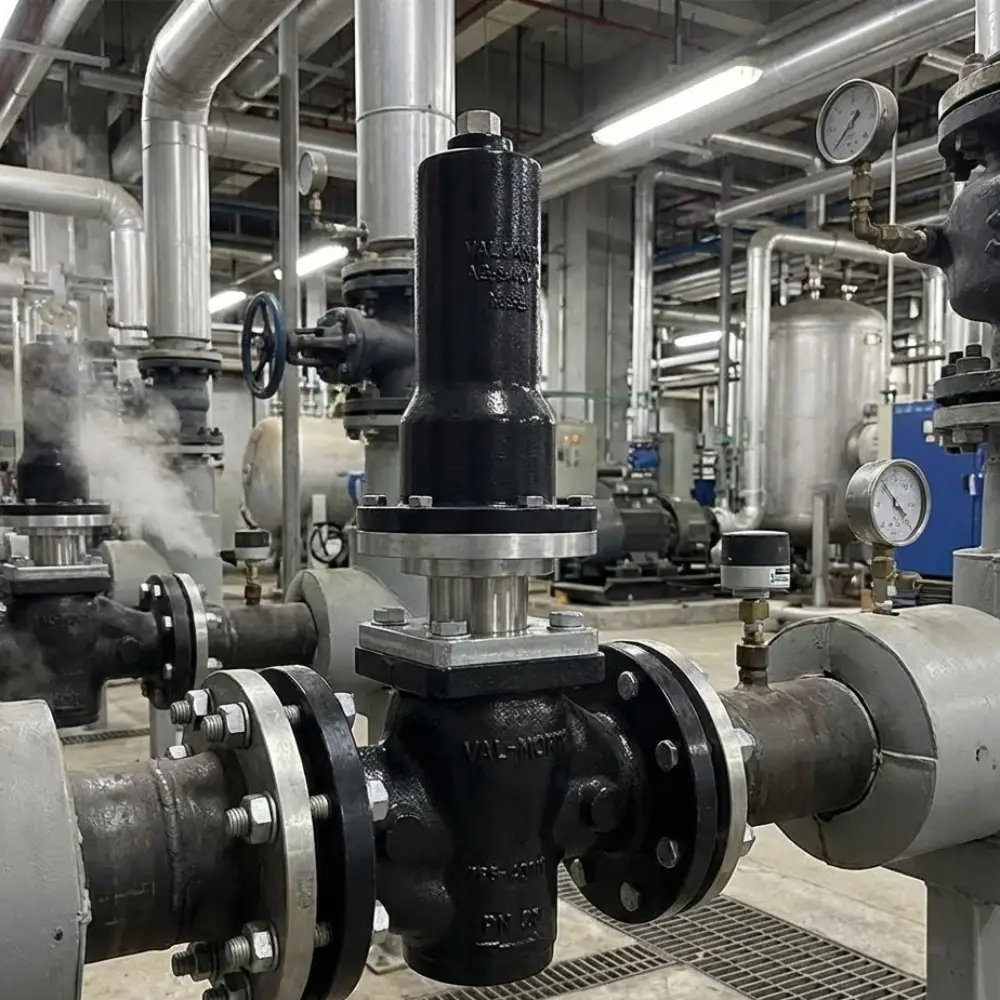
The reducing valve is installed on the water inlet pipe, after the water meter and the main shutoff valve, so that it protects the entire installation downstream. The adjusting screw should be left accessible and, whenever possible, a pressure gauge should be fitted downstream to check the outlet pressure.
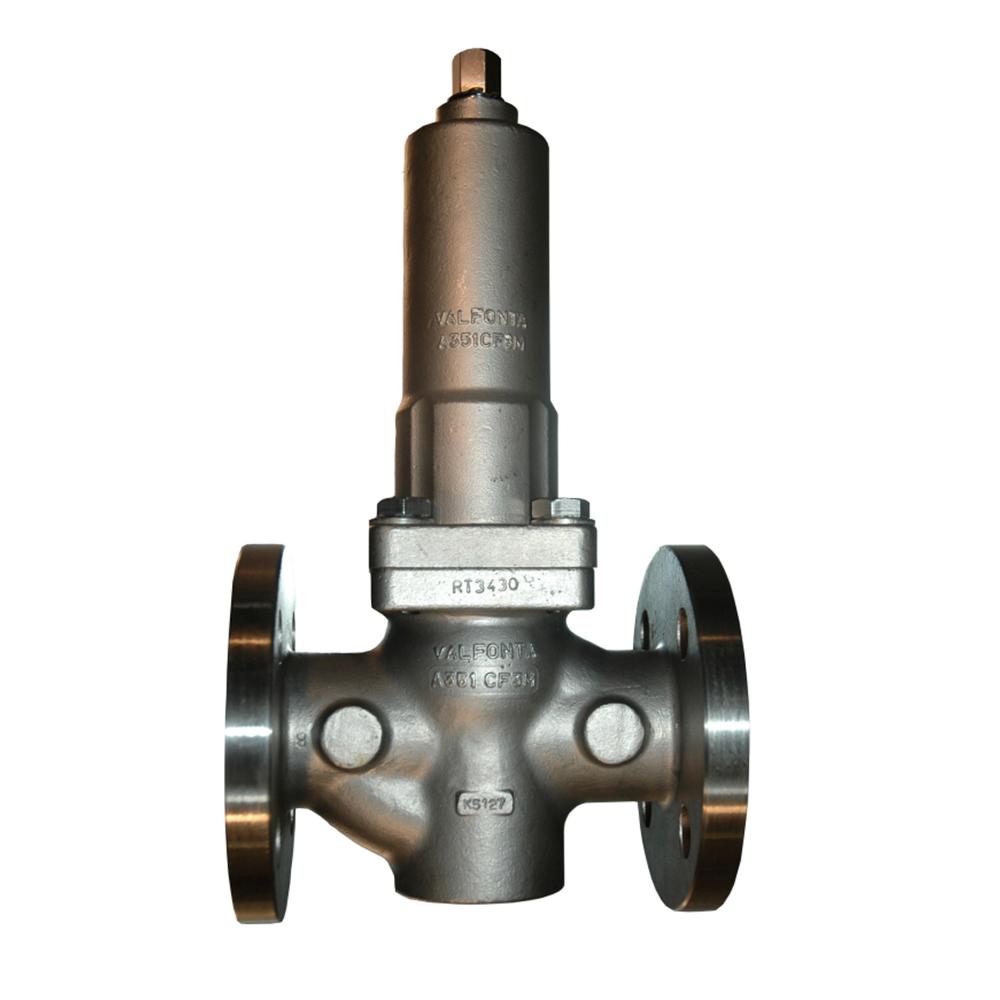
As a general rule, it is advisable to install a shutoff valve before and after the reducing valve so maintenance can be done without draining the whole line. Many models, such as Valfonta’s, can be mounted in different positions and allow access to the mechanism without dismantling the service line, which greatly simplifies installation and inspection.
How to adjust the outlet pressure
Adjustment is done with the valve in service and some demand open, using the adjusting screw: compressing the spring raises the outlet pressure, and loosening it lowers it.
The ideal value depends on the application, but in domestic water installations it is usually between 2.5 and 3.5 bar, without exceeding the 5 bar set by building regulations for the point of use.
After adjusting, check the reading on a pressure gauge and make sure the pressure stays stable both under demand and at rest. You can find more information in our articles on how to adjust a pressure reducing valve and where to install a pressure reducing valve.
How to choose your water pressure reducing valve
Not every reducing valve suits every installation. Choosing well means assessing the service conditions and the performance of the equipment.
Technical selection criteria
Before deciding on a model, be clear about the following parameters:
Maximum inlet pressure and desired outlet pressure, to confirm they fall within the valve’s regulating range.
Required flow and Kv coefficient, which determine the size and prevent pressure drops or instability.
Size and connection type (threaded, flanged, BW/SW welded, or clamp) to match the pipe.
Body and gasket materials, depending on the fluid, the temperature, and the sanitary or chemical requirements.
Special requirements: oxygen service, demineralized water, corrosive environments, or specific certifications.
When in doubt, the safest option is to get advice from a manufacturer who will study the system and propose the valve that best fits each need.
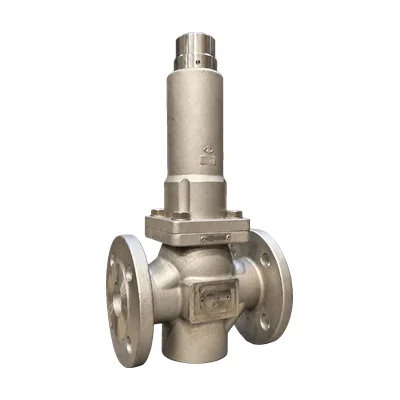
The Valfonta PRV30 and options on request
In addition, the PRV30 can be configured on request with additional features:
Kv reduced to 0.2 | 0.4 | 0.6 | 1 m³/h.
Body and cover in bronze or Super Duplex.
BW or SW welded connection, and clamp connection.
Valve fully degreased for oxygen service.
Soft seals in EPDM, PEEK, Viton, Aflas, and other materials.
You can view the full product page for the PRV30 pressure reducing valve or see the whole range in the pressure reducing valves category.
| Feature | PRV30 specification |
|---|---|
| Type | Direct-acting, self-compensated by piston |
| Maximum allowable pressure | 25 bar |
| Regulating pressure range | 0.5 – 12 bar |
| Body material | AISI 316 stainless steel |
| Advantages | Easy installation, low maintenance, mounting in several positions, and highly reliable regulation |
You will find all models, with their pressure ranges and materials, on our pressure reducing valves page.
Frequently asked questions
What should the water pressure be in a home?
In domestic water installations, a working pressure of 2.5 to 3.5 bar is recommended. Building regulations require a minimum of approximately 1 bar at the points of use and set a maximum of around 5 bar; above that value, a reducing valve should be installed to protect the installation.
Where is a water pressure reducing valve installed?
It is installed on the inlet pipe, after the water meter and the main shutoff valve, so that it protects the entire installation downstream. It is advisable to leave the adjusting screw accessible, fit a pressure gauge downstream, and provide shutoff valves before and after to make maintenance easier.
How do I know if the pressure reducing valve is faulty?
The most common signs are an outlet pressure that does not stay stable or that rises above the set value (especially with no demand), noise or vibration, or being unable to adjust it with the screw. If you see these symptoms, check the gaskets, spring, and seat. Our article on pressure reducing valve problems can help.
What is the difference between a reducing valve and a relief valve?
A reducing valve continuously controls and limits the downstream pressure, keeping it stable at a working value. A relief valve is a safety device that only acts when the pressure exceeds a limit, discharging fluid to protect the system. One regulates; the other protects against occasional overpressure.
How often should the valve be inspected or serviced?
It depends on the water quality and the service conditions, but an annual inspection is recommended to check the outlet pressure and the condition of the gaskets. With water that carries sediment or scale, and in demanding industrial applications, inspections should be more frequent. Easy-access models such as the PRV30 allow these inspections without dismantling the line.
What size do I need: ¾, 1, 2...?
The size is not chosen by pipe diameter alone, but by the flow and the allowable pressure drop. A ¾" reducing valve is common in domestic installations and small commercial lines, while higher flows require larger sizes. Ideally, it should be sized from the design flow; Valfonta’s technical team can help you determine the right size.
Related valves
Related articles
Can we help with your installation?
Tell us the fluid, the inlet and outlet pressures, the temperature, and the flow rate, and we will recommend the right valve.
You can also call 933 720 888 or email valfonta@valfonta.com.