


Excess pressure valve · Bellows-balanced
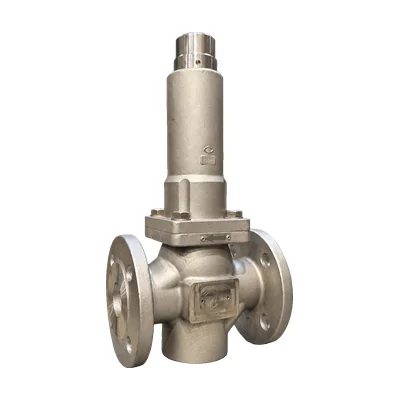
PRV54 excess pressure valve
Up to 210 °C
Self-regulating, direct-acting, bellows-balanced excess pressure valve with body, cap, and internals in 316L stainless steel. It keeps the line pressure stable and discharges the excess when the set pressure is exceeded, on steam, liquids, and gases up to 210 °C.
- SizesDN15 to DN25
- Pressure ratingPN25
- Set pressure range0.5 to 12 barg depending on spring
- Inlet pressureup to 16 barg
- Temperature−30 to 210 °C depending on gaskets
- Kv2 to 3.5 m³/h
Configure your valve
Questions about set pressure or sizing? Call 933 720 888 or email valfonta@valfonta.com.
- In-house design and manufacturing in Badalona
- ATEX II 2 GD marking for zones 1 and 21
- Microplasma-welded stainless steel bellows
- Genuine spare parts available
What the PRV54 is used for
The PRV54 is a self-regulating excess pressure valve: it needs no auxiliary power or pilot line. When the upstream pressure exceeds the set value, it opens proportionally and relieves the excess, so the line pressure is held at the set value.
It has the same dimensions as the PRV53, but incorporates a stainless steel bellows and graphite-filled PTFE gaskets that allow it to work with steam up to 210 °C. More detail in our article on the bellows valve.
- Steam plantsPressure limiting in steam networks and heat exchangers.
- Chemical laboratoriesStable pressure in steam, liquid, and gas circuits.
- Sanitary plantsCircuits that require stainless steel.
- Compressed air and sprinklersLimits network pressure to the set value.
- Fuel oil and oilsGroup 1 and 2 fluids; special gaskets for mineral oils.
- Dry cleaners and laundriesAlso stills, ironing cylinders, and vulcanizers.
- Mining slurry linesRelief for abrasive concentrate and tailings pipelines: pressure relief in mining slurry lines.
PRV54 technical specifications
| Type | Self-regulating, direct-acting, bellows-balanced excess pressure valve |
|---|---|
| Sizes | DN15 (½″), DN20 (¾″), and DN25 (1″) |
| Connections | BSP or NPT thread · EN PN16/25 flanges · ANSI CL150 flanges · Clamp on request |
| Pressure rating | PN25 |
| Maximum inlet pressure | 16 barg |
| Set pressure ranges | 0.5 – 4 barg · 3 – 8 barg · 4 – 12 barg (depending on spring) |
| Kv coefficient | 2 m³/h (DN15) · 2.5 m³/h (DN20) · 3.5 m³/h (DN25). Special Kv on request |
| Temperature depending on gaskets | PTFE+GR: −30 to +210 °C · NBR: −20 to +80 °C · EPDM: −30 to +125 °C · FKM: −10 to +150 °C |
| Fluids | Group 1 and 2 liquids and gases: steam, oil, compressed air, fuel oil, water, nitrogen, inert gases |
| Materials | Body, cap, and internals in AISI 316L stainless steel. Microplasma-welded stainless steel bellows |
| Mounting position | Liquids and gases below 150 °C: any position. Steam (above 150 °C): horizontal pipe with the actuator facing down |
| Pressure Equipment Directive | PED 2014/68/EU, Article 4.3: CE marking not required (Group 1 and 2 fluids) |
| ATEX | II 2 GD c IIC Tx / c IIIC TxºC · certificate LOM 14.034 U |
| On request | Body in bronze or super duplex · special gaskets (NBR or FKM for mineral oils, EPDM, PEEK, Aflas) · weld ends (socket weld or butt weld) · degreased for oxygen service |
Dimensions and weight
| ½″ threaded | ¾″ threaded | 1″ threaded | DN15 EN | DN20 EN | DN25 EN | DN15 ANSI | DN20 ANSI | DN25 ANSI | |
|---|---|---|---|---|---|---|---|---|---|
| Kv (m³/h) | 2 | 2,5 | 3,5 | 2 | 2,5 | 3,5 | 2 | 2,5 | 3,5 |
| Length A / AA | 108 | 108 | 108 | 130 | 150 | 160 | 184 | 184 | 184 |
| Height H1 | 135 | 135 | 135 | 135 | 135 | 135 | 135 | 135 | 135 |
| Height H2 | 185 | 185 | 185 | 185 | 185 | 185 | 185 | 185 | 185 |
| Flange Ø D1 | – | – | – | 95 | 105 | 115 | 89 | 98 | 108 |
| Weight (kg) | 3,5 | 3,5 | 3,5 | 5 | 5 | 5 | 5 | 5 | 5 |
Dimensions in millimeters. The dimensioned drawings and the remaining flange dimensions are in the PDF datasheet.
Exploded view and materials (21 parts)
| No. | Part | Material |
|---|---|---|
| 1 | Body | Stainless steel AISI 316L |
| 2 | Sealing screw | Stainless steel A2-70 |
| 3 | Seat | PTFE+GR, NBR, FKM… |
| 4 | Gasket | PTFE |
| 5 | Seat | Stainless steel AISI 316L |
| 6 | Gasket | PTFE |
| 7 | Cap | Stainless steel AISI 316L |
| 8 | Spring washer | Steel ST-52 |
| 9 | Adjusting screw | Stainless steel A4-70 |
| 10 | Adjusting spring | Steel 52SiCrNi5 |
| 11 | Bellows screw | Stainless steel AISI 316L |
| 12 | Gasket cover | Stainless steel AISI 316L |
| 13 | Bellows assembly | Stainless steel |
| 14 | Allen screw | Stainless steel A2 |
| 15 | Gasket | Graphite-filled PTFE |
| 17 | Stem | Stainless steel AISI 316L |
| 18 | Seat guide | Stainless steel AISI 316L |
| 19 | Closing spring | Stainless steel AISI 302 |
| 20 | Spring guide | Stainless steel AISI 316L |
| 21 | Bottom cover | Stainless steel AISI 316L |
| 22 | Gasket | PTFE (NBR, EPDM…) |
Recommended spare parts
| Reference | Description | Parts |
|---|---|---|
| PRV54.SP1 | Gasket and balancing system kit | 2, 3, 11, 12, 15, 17, and 18 |
| PRV54.SP2 | Gaskets | 6 and 22 |
| PRV54.SP3 | Springs | See the manual |
| PRV54.SP4 | Bellows | 13 |
How the PRV54 works
The PRV54 works on a balance between the adjusting spring and the inlet pressure, with no air or electricity.
- Closed without pressure. As long as the inlet pressure has not reached the set pressure, the adjusting spring (10) keeps the valve closed.
- Sensing. The upstream pressure acts on the piston and the seat assembly, and reaches the bellows through the stem. The assembly is balanced.
- Proportional opening. When the inlet pressure exceeds the set point, the valve opens in proportion to the pressure rise.
- Relief. As the excess flow is discharged, the line pressure is held at the set value. If it drops, the spring closes the valve again.
PRV54 installation
The manual shows the PRV54 installed in a pipe with its isolation valves, a strainer, and pressure gauges at the inlet and outlet.
Installation and start-up
- Clean the pipe before installing the valve: any particle can damage the seat.
- Install a strainer upstream of the valve to protect the seat.
- Follow the arrow on the body and, whenever possible, install the valve in a horizontal pipe.
- Orient the valve according to the fluid: with liquids and gases below 150 °C, any position is allowed; with steam, a horizontal pipe with the actuator facing down.
- Support the pipe, not the valve: supports should be as close as possible to the valve, but never attached to it.
- Install isolation valves upstream and downstream, and a pressure gauge at the inlet to read the set pressure.
- Start up slowly: open the isolation valves gradually to avoid water hammer.
- Adjust the set pressure with an 8 mm Allen key on the adjusting screw. Compressing the spring raises the set pressure; releasing it lowers it.
The valve must be installed by qualified personnel and must never exceed the operating pressure and temperature for which it was sized. In ATEX zones, the valve must be equipotentially bonded to the installation. See also how to prevent water hammer in pipes.
PRV54 technical documentation
Do you need an order certificate or the ATEX documentation? See our quality certificates or request it from our technical team.
PRV54 vs. other excess pressure valves
The range covers DN15 to DN150 and set pressures from 0.01 to 20 barg. Check whether the PRV54 is the right model or whether another one suits you better.
| Model | DN | PN | Set pressure (barg) | Max. T (°C) | Steam | Body |
|---|---|---|---|---|---|---|
| PRV53 | 15 – 25 | 25 | 0,5 – 15 | 150 | No | CF3M stainless |
| PRV54 | 15 – 25 | 25 | 0,5 – 12 | 210 | Yes | CF3M stainless |
| PRV55 | 15 – 25 | 25 | 0,01 – 8 | 150 | Yes | CF3M stainless |
| S1 | 15 – 150 | 40 | 0,5 – 15 | 220 | Yes | WCB steel or CF3M stainless |
| S2 | 15 – 100 | 40 | 0,02 – 10 | 180 | Yes | WCB steel or CF3M stainless |
| S3 | 15 – 150 | 40 | 0,5 – 20 | 220 | Yes | WCB steel or CF3M stainless |
| S4 | 15 – 100 | 40 | 0,5 – 20 | 220 | Yes | WCB steel or CF3M stainless |
Data from the Valfonta excess pressure valve summary catalog (2025), except the S2 set pressure, which comes from its datasheet. All models accept liquids, oil, air, and non-flammable gases. If you are unsure whether you need an excess pressure valve or a safety valve, read the difference between a safety valve and a relief valve.
Frequently asked questions about the PRV54
Can the PRV54 be used with steam?
Yes. With graphite-filled PTFE gaskets, it handles up to 210 °C. With steam, or with fluids above 150 °C, it must be installed in a horizontal pipe with the actuator facing down.
What set pressure can be adjusted?
It depends on the spring: there are three ranges, 0.5 to 4, 3 to 8, and 4 to 12 barg. The maximum inlet pressure is 16 barg.
How do you adjust the set pressure of the PRV54?
With an 8 mm Allen key on the adjusting screw. Compressing the spring raises the pressure at which the valve opens; releasing it lowers it. Check the value on the inlet pressure gauge and see our guide on relief valve set pressure.
What is the difference between the PRV54 and the PRV53?
They have the same sizes, the same pressure rating, and the same dimensions. The PRV54 is bellows-balanced and, with graphite-filled PTFE gaskets, works with steam up to 210 °C. The PRV53 is not suitable for steam, reaches 150 °C, and offers set pressures up to 15 barg on request.
What maintenance does it need?
It requires no periodic maintenance, but the gaskets and wear parts should be checked according to the service conditions. This can be done with the valve installed, depressurized, and isolated. Kits are available for the gaskets and balancing system (PRV54.SP1), gaskets (PRV54.SP2), springs (PRV54.SP3), and bellows (PRV54.SP4).
Does the PRV54 carry CE marking?
No. Given its size (DN15 to DN25) and pressure rating (PN25), it falls under Article 4.3 of the Pressure Equipment Directive 2014/68/EU, with Group 1 and 2 fluids.
Can it be installed in an ATEX zone?
Yes. The PRV54 carries ATEX II 2 GD marking (certificate LOM 14.034 U) and can be used in zones 1 and 2 (flammable gases, vapors, and liquids) and 21 and 22 (combustible dust), according to the temperature class that corresponds to the fluid temperature. See our article on ATEX valves.
Other excess pressure valve models
- PRV53 excess pressure valveSame dimensions in 316L stainless, no steam, and set pressure up to 15 barg.
 PRV55 excess pressure valveWith diaphragm: set pressure from 0.01 barg and steam up to 150 °C.
 S1 excess pressure valveFrom DN15 to DN150 and PN40, for steam up to 220 °C.
 S2 excess pressure valveFrom DN15 to DN100, PN40, and set pressure from 0.02 barg.
 S3 pressure relief valveFrom DN15 to DN150, PN40, set pressure up to 20 barg and 220 °C.
Request a quote for the PRV54
Give us your installation details and we will recommend the size, the spring range for your set pressure, and the gaskets suited to the fluid and temperature.
- Fluid and operating temperature
- Set pressure and normal operating pressure
- Flow rate the valve must discharge
- Connection type (threaded or flanged)
You can also call 933 720 888.